Grizzly Junk Pros · Family-owned since 2014 · 4.99 ★ × 463 reviews · 20,000+ jobs
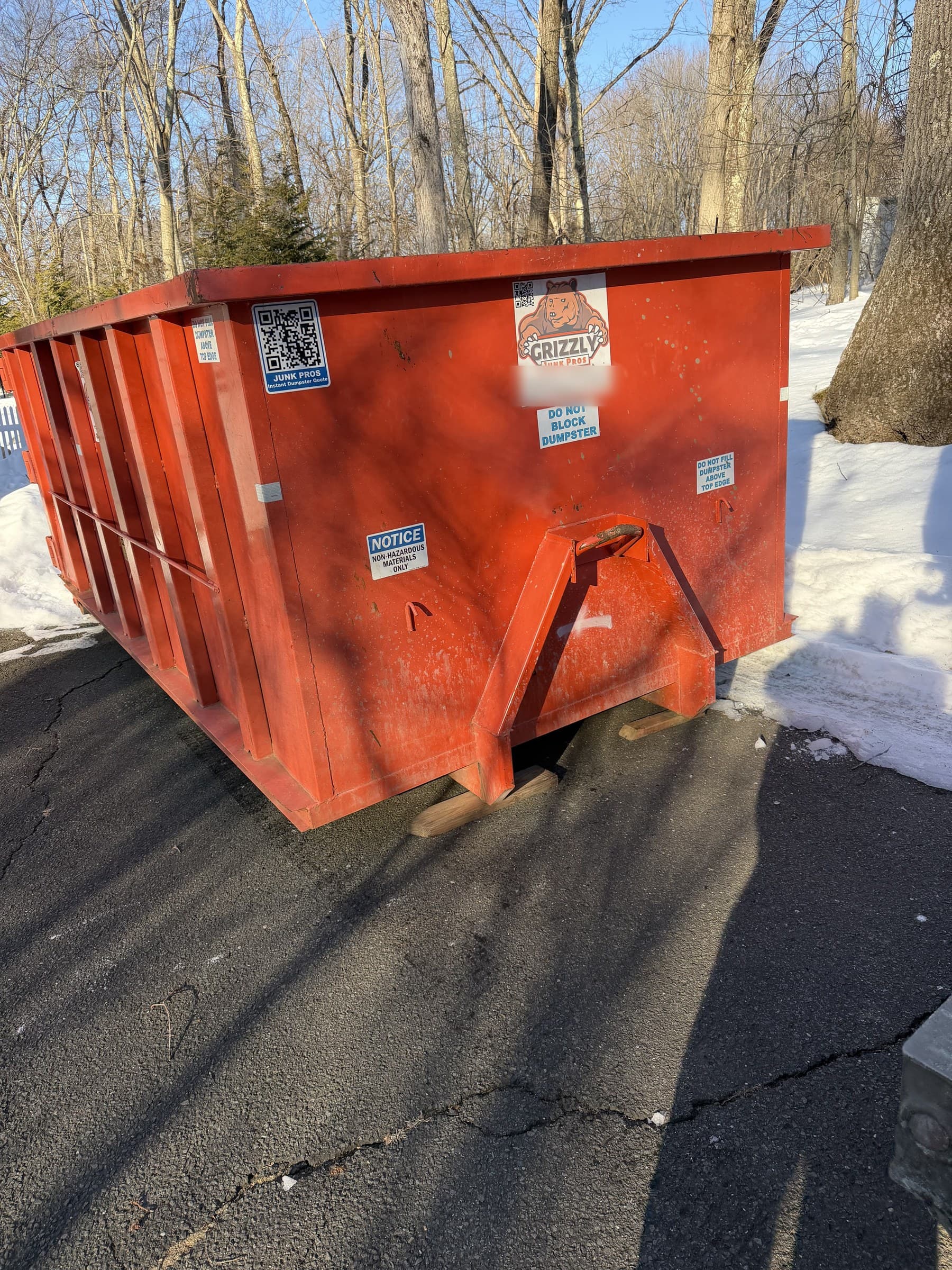
Dumpster Placement in Connecticut: Driveway vs. Street
When a customer tells us where to put it, it's the driveway 19 times out of 20. Why the driveway wins, when the street means a town permit, and how a careful crew protects the surface either way.
20,000+
jobs completed
4.99 ★
463 reviews
Family-owned
since 2014 (12 years)
Licensed & insured
in Connecticut & New York
Last updated: September 6, 2026 · Placement figures from written placement notes on Grizzly Junk Pros orders · Refreshed annually
The first question on every delivery isn't the size of the can — it's where the can goes. Get that right and the whole rental is boring in the best way: the truck backs in, the boards go down, the can lands, everyone goes back to work. Get it wrong and you're suddenly reading your town's right-of-way ordinance at 7 AM while a roll-off truck idles at the curb.
Here's the short version, straight from our own dispatch records: When a customer tells us where to put it, it's the driveway 19 times out of 20. That figure comes from orders that carry a written placement note — direct rentals with a written placement note (Grizzly Junk Pros job data, 2026 detail, n=284) — so read it as what customers who spell out a spot ask for, not a census of every rental. But the lopsidedness is the point. When people think about where the can should go, they almost never pick the street.
Why the driveway wins
- No permit, in most towns. Your own driveway is private property; in most Connecticut towns, nobody at town hall needs to know a dumpster is on it. Street or public right-of-way placement is different — most CT towns require a permit for that, with the usual application, fee, and lead time. Rules vary town to town, so treat this as the general shape, not your town's fine print.
- No traffic exposure. A can in the street needs cones, sometimes reflectors, and it collects door dings and close calls. A can in the driveway collects debris.
- Shorter carries. The debris is at the house. The closer the can sits to the work, the fewer steps every armload takes — a detail your back discovers around hour three.
In the same placement notes, street-or-curb placement shows up on just 2.1% of noted orders and lawn placement on 2.5% (Grizzly Junk Pros job data, 2026 detail, n=284). The street is the fallback, not the default — usually a downtown property with no driveway, or a shared drive nobody can block. If that's you, call your town's public works or building office about a street-occupancy permit before you book. The building-department contacts we've verified town by town are collected in the CT Transfer Station Guide.
The boards go down first
A roll-off can rides on two steel rails, and steel is honest about weight — it concentrates every loaded pound onto two narrow lines. So the crew puts wood down first: boards or plywood sheets under the rails, spreading the load across the surface the way a snowshoe spreads a footstep. On a hot August day, asphalt is soft enough to take a rail print without the wood; with it, the can leaves nothing behind but the outline of a finished project.
Fresh sealcoat, pavers, a driveway you just had redone — tell us at booking. Placement is a conversation, not a coin flip.
Delivery morning, minute by minute
About 2 in 3 deliveries are scheduled before 8:30 AM (Grizzly Junk Pros job data, 2026 detail, dumpster deliveries, n=989). That's deliberate — the can is on site before the workday starts. It also means the approach needs to be clear before most households have moved their cars.
That's what "we'll call when we're on the way" is for. The truck needs a straight, unobstructed line to the drop spot: no cars across the apron, no closed gate, no low-hanging surprise. The heads-up call gives whoever's home ten minutes to move vehicles — and those ten minutes are the whole game. Trip charges are genuinely rare here (about 1 in 80 rentals across 2023–2025 (Grizzly Junk Pros job data, 2023–2025 direct rentals)), and every single one traces to the same cause: the can could not be picked up or had to be relocated — blocked access, a vehicle in the way, a load above the rim, or a can moved from where it was placed.
One more delivery-morning decision: which way the door faces. Every can in our fleet is the same can — about the length of one parking spot, with a rear swing door with step-in access on every can — and that rear door is how heavy items walk in instead of going over the wall. Tell us where the debris is coming from and we'll land the can door-end toward the work, with clear space behind it for the swing. (More on the one-can fleet and why every size arrives in the same box: One Can. Every Job.)
While the can sits there
- Keep the load below the rim. An over-the-rim load can't be tarped or legally hauled, and it's one of the causes behind that trip-charge stat above. Pickup morning has its own short checklist — five habits that keep a wasted roll off your invoice.
- Load heavy through the door, light over the walls. Walk the dense stuff in first, floor it evenly, then fill upward.
- Mind the weight, not just the space. Placement is the easy half of the rental; weight is the half that shows up on invoices. The overage fee guide and the real-world weight data cover that side.
- Watch what goes in. Mattresses, refrigerant appliances, and tires each carry a per-item fee with a regulation behind it — the extra-fees guide has the details and the free routes around them.
Towns where we've verified the local disposal and permit contacts
Street placement means town rules, and town rules mean the right office. For these Connecticut towns we've verified municipal facts from the town's own official site — each town page below carries a “Disposal in {Town}” section with the verified building-department and transfer-station contacts:
- Avon
- Barkhamsted
- Berlin
- Bethel
- Bethlehem
- Bloomfield
- Branford
- Bridgeport
- Bridgewater
- Bristol
- Brookfield
- Burlington
- Canaan (Falls Village)
- Canton
- Cheshire
- Chester
- Clinton
- Colebrook
- Cornwall
- Cromwell
- Danbury
- Darien
- Deep River
- Derby
- Durham
- East Haddam
- East Hampton
- East Hartford
- East Haven
- East Lyme
- Easton
- Enfield
- Essex
- Fairfield
- Farmington
- Glastonbury
- Goshen
- Granby
- Greenwich
- Guilford
- Haddam
- Hamden
- Hartford (capital city)
- Hartland
- Harwinton
- Hebron
- Kent
- Killingworth
- Litchfield
- Lyme
- Manchester
- Marlborough
- Meriden
- Middlebury
- Middlefield
- Middletown
- Milford
- Monroe
- Montville
- Morris
- Naugatuck
- New Britain
- New Canaan
- New Hartford
- New Haven
- New Milford
- Newington
- Newtown
- Norfolk
- North Canaan
- North Haven
- Norwalk
- Old Lyme
- Old Saybrook
- Orange
- Plainville
- Plymouth
- Portland
- Redding
- Ridgefield
- Rocky Hill
- Roxbury
- Salem
- Salisbury
- Sharon
- Shelton
- Sherman
- Simsbury
- South Windsor
- Southington
- Stamford
- Stratford
- Suffield
- Thomaston
- Torrington
- Trumbull
- Wallingford
- Warren
- Washington
- Waterbury
- Waterford
- Watertown
- West Hartford
- West Haven (depot town)
- Westbrook
- Weston
- Westport
- Wethersfield
- Wilton
- Winchester / Winsted
- Windsor
- Windsor Locks
- Woodbridge
- Woodbury
Every verified fact, with its source link, is also collected in the CT Transfer Station Guide.
Methodology
The placement split comes from Grizzly Junk Pros dispatch records — direct rentals with a written placement note, n=284, 2026 detail. It describes orders where the customer wrote down a placement, not all rentals. Delivery-day and trip-charge figures come from the same job-record system (deliveries n=989; trip-charge shares, 2023–2025 direct rentals). Permit statements on this page are deliberately general — Connecticut placement rules are town by town, and your town hall is the authority for yours.
Placement FAQs
Do I need a permit to put a dumpster in my driveway in CT?
In most Connecticut towns, no — a dumpster on your own private driveway is your business, no town paperwork involved. That's the single biggest reason the driveway wins: it turns delivery into a scheduling question instead of a permitting question. Street or right-of-way placement is the opposite story — most CT towns require a permit for anything parked in the public way. Rules are town-by-town, so when the driveway genuinely won't work, call your town hall before you book.
Where do most people actually put the dumpster?
When a customer tells us where to put it, it's the driveway 19 times out of 20. That's from written placement notes on our own orders — direct rentals with a written placement note (Grizzly Junk Pros job data, 2026 detail, n=284) — not a guess. Street and curb placement barely registers in those notes, and every street placement adds the permit question on top.
Will the dumpster damage my driveway?
The can rides on steel rails, and steel concentrates weight — so we put wood between the rails and your surface. Boards or plywood sheets spread the load the way a snowshoe spreads a footstep, which matters most on asphalt in summer heat and on pavers. It's a standard part of a careful delivery, not an upsell. If your driveway is freshly sealed or the surface worries you, say so at booking and we'll plan the placement around it.
What does "call when you're on the way" actually mean?
It means the ten minutes that save a $95 trip charge. The truck needs a clear straight shot to the drop spot — no cars parked across the approach, no gate swung shut. We call ahead so anyone home can move vehicles before we arrive, because about 2 in 3 deliveries are scheduled before 8:30 AM (Grizzly Junk Pros job data, 2026 detail, dumpster deliveries, n=989) — often before the household is up and out. Trip charges are rare (about 1 in 80 rentals across 2023–2025 (Grizzly Junk Pros job data, 2023–2025 direct rentals)), and in every case the cause was the same: the can could not be picked up or had to be relocated — blocked access, a vehicle in the way, a load above the rim, or a can moved from where it was placed.
Which way does the rear door open, and why does it matter?
Every can in our fleet has a rear swing door — it opens outward from the back of the can, so you can walk heavy items in instead of lifting them over the wall. On delivery day that means one thing: think about which end of the can should face your work. Tell us where the debris is coming from and we'll drop the can door-end toward it, with enough clear space behind for the door's swing.
More from this series: the overage fee guide, the extra-fees guide, and the Connecticut Dumpster Price Index. Sizes and posted rates live on the dumpster hub and the pricing reference.
Tell us where the debris is — we'll land the can to match
Call (203) 219-8855 or book online. Boards under the rails, door toward the work, heads-up call before the truck turns in. Phones answered 8 AM – 10 PM, 7 days; live team Mon–Fri 8 AM – 4 PM, AI phone assistant other times.