Grizzly Junk Pros · Family-owned since 2014 · 4.99 ★ × 463 reviews · 20,000+ jobs
Shed Removal in Fairfield County, CT
Fairfield County sheds come down inward, load fast, and leave nothing on the neighbor's side of the line — that's the whole trick on a tight lot.
On a Fairfield County lot, a shed tear-down is a precision exercise before it's a demolition. The county's lots run dense — the shed sits four feet off the property line, the neighbor's perennial bed starts where your fence ends, and there is no version of this job where debris gets to land anywhere careless. Walls drop inward onto the footprint, every time, because inward is the only direction that belongs to you.
The sheds themselves skew old. The coastal towns' housing stock — Stamford, Norwalk, Bridgeport — dates back generations, and the sheds behind those houses often do too: real-lumber structures with three roofing layers and forty years of accumulation inside. Contents get quoted as junk removal alongside the structure, one crew, one visit.
We've been based in Stamford since 2014, so this is the county where our shed judgment was formed. The walkthrough paces the carry path, the price gets fixed in writing, and by early afternoon there's a raked rectangle where the shed stood — with the neighbor none the wiser except for the noise at coffee time.
Why it costs less here
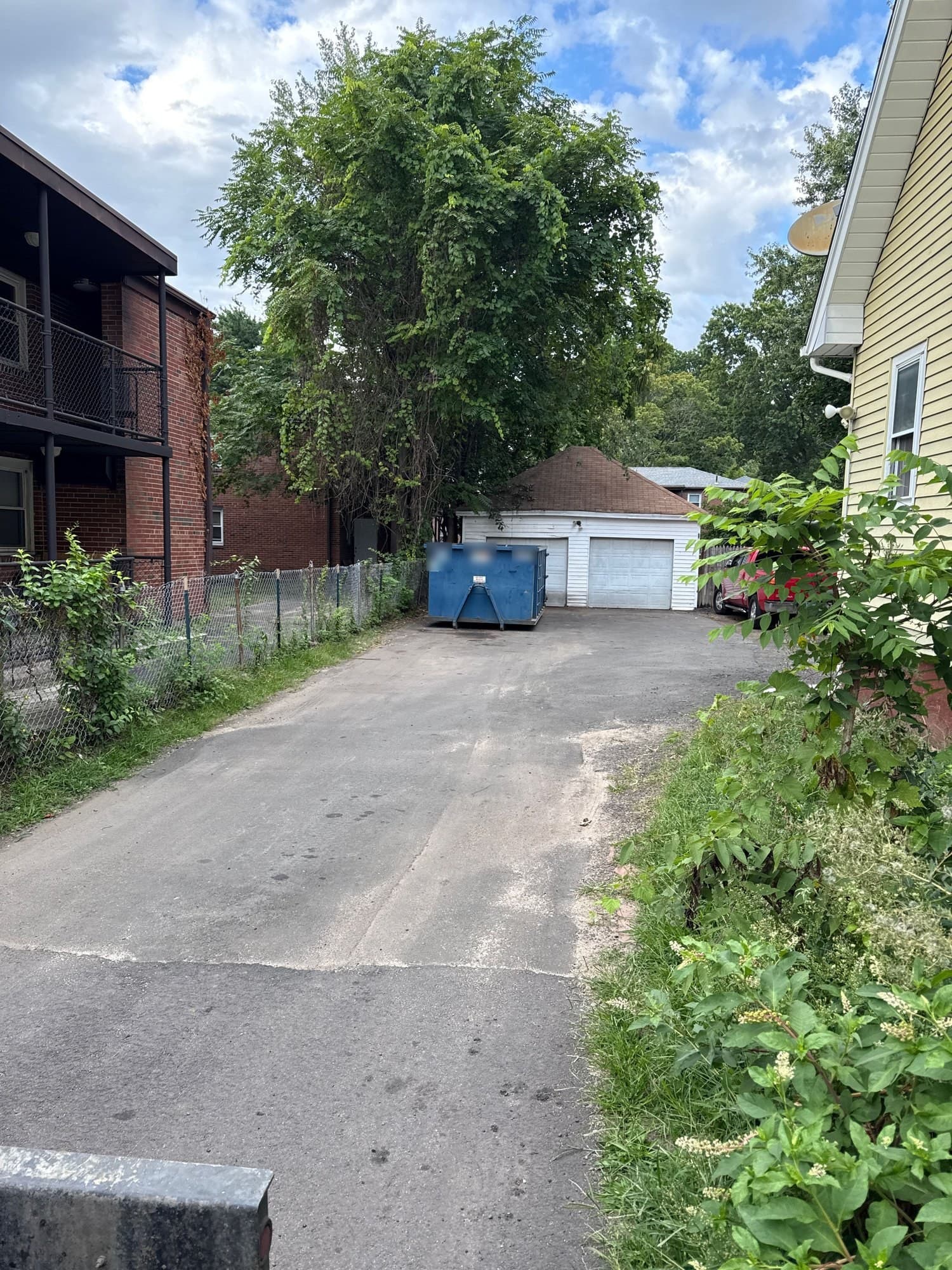
On a tight Fairfield County lot, the cost advantage is the chain being one link long: the crew that drops the shed owns the can it goes into, the truck that hauls it, and the disposal route it rides. There's no rented roll-off marked up into your quote and no second company splitting the ticket. One visit, one invoice, and the driveway is clear by dinner.
Working four feet from the property line
Two Fairfield County facts shape every shed job here. First, the routing: the Merritt Parkway prohibits commercial vehicles, so our trucks arrive by I-95 or Route 7 and Route 8 — planned into every schedule, invisible in your price. Second, the geometry: dense lots mean the truck often can't get near the shed, so debris carries out in armloads and cart runs through a gate or the strip between houses.
That carry is what the walkthrough measures. A shed thirty feet from the driveway and a shed at the back of a long, fenced yard are the same tear-down but a different loading job, and the up-front price reflects the real path, not a guess. The county sits within a ~30–75 minute band of our West Haven yard, with our Stamford yard covering the lower county.
Square footage sets the floor; the walk sets the rest
Shed pricing runs on two tiers — smaller structures on one line, the bigger doubles and barn-adjacent buildings on the other — and the grid above renders both starting figures live from the same canonical data as the demolition hub. Material barely moves the number: metal sheds come apart fast and load light, resin unclips, wood takes longest but loads most predictably. Material changes the method, not the answer.
What does move the number is what the walkthrough measures. How far the shed sits from where the truck can park. Whether the path runs through a gate, down a slope, or around the good landscaping. And what's inside — a shed still full of forty years of accumulation gets its contents quoted as junk removal alongside the structure, one visit, one crew, everything gone.
The price gets fixed in writing before anyone picks up a tool, and it includes the tear-down, the loading, the disposal, and the raked footprint. Up-front pricing, no dump-fee surprise on the back end. For the deeper math — including what the DIY version costs in dump runs and weekends — our shed demolition cost guide walks the whole thing.
One more thing about the map: we take sheds down anywhere in Connecticut, each priced per job — footprint, build, access, and distance all move the number. Photos or a Street View link sent through the demolition quote form get you a real number back, not a range, and the price we quote is the price you pay.
Demolition pricing — published starting ranges
Every demo job is different — final quote confirmed on site after walkthrough. These are honest starting ranges so you can self-qualify before calling. Disposal of all materials is included in the total.
- Sheds (8x10 to 10x12)$1,195+
Wood-frame, on-grade or skid foundation, single-day teardown.
How this job goes →Get a quote for your project → - Sheds (12x16+) and outbuildings$1,725+
Larger wood-frame outbuildings.
How this job goes →Get a quote for your project →
How the pricing works: These are starting prices, and most jobs land here. Every one includes teardown, loading, hauling, and full disposal — no separate dump fee, no labor line added later. What moves the number up: size, how far the structure sits from where the truck can park, whether the crew has to carry debris through a gate or around a house, material, footings or a slab, and distance from our depots for jobs outside Fairfield and New Haven County. Concrete stays unless it's quoted. Send photos and we'll give you a real number — the price we quote is the price you pay, confirmed on site before anything comes down. We don't pull demo permits — that's the homeowner's responsibility when required.
Standalone outbuildings only — no interior demo, no full-house teardowns, no asbestos.
See demolition scopeTop down, walls inward
Every shed comes down in the same order, because the order is what keeps the job boring in the good way. Doors and windows come out first. The roof gets cut loose in sections — never pushed off whole. Then the walls drop inward, onto the footprint, where the debris can't reach anything you care about. Everything loads as it comes down, so the site never sits buried under a pile waiting for the truck.
A typical backyard shed is a morning: dismantle, load, rake. Bigger or double-walled structures run into the afternoon. Either way it's one visit — we don't leave a half-collapsed shed standing over a weekend.
The last twenty minutes matter as much as the first. The footprint gets raked flat, fasteners and glass picked out, and anything that was resting on grade — piers, skids, blocking — loaded with the structure. What you're left with is a rectangle of bare ground and whatever plans you have for it. The debris rides out in our own cans — a hundred of them on one 15-by-8-foot footprint — which is why the crew never waits on a rented container from somebody else's yard.
The structure goes; concrete doesn't
Every material a shed comes in, we take: wood, metal, plastic, resin, and the mixed generation of all four that a shed acquires over thirty years of patches. Roofing, siding, framing, shelving, the workbench bolted to the wall — all of it loads. Contents count too, quoted as junk removal alongside the structure, so tell us roughly what's inside at booking and we'll bring the right truck space.
The hard line is concrete, dirt, and stone — none of it rides in our cans, no exceptions. A poured pad stays and becomes the base for whatever replaces the shed. Footings below grade stay in the ground. Piers and skids just resting on the surface are the exception: those come along with the structure.
Two more honest boundaries. Anything with live utilities has to be dead first — a shed with a power feed needs the line disconnected before the crew starts, same rule as every powered structure we touch. And permit questions belong to your town's building department, not to us: many CT towns treat small accessory structures as permit-free to remove, some don't, and one five-minute call answers it for your address.
Shed Removal in Fairfield County — questions we actually get
How long does a shed tear-down take?
A typical 8x10 or 10x12 is a morning. Door and windows out, roof cut loose in sections, walls dropped inward, everything loaded, footprint raked. Bigger or double-walled structures run into the afternoon.
Can you take a shed that still has stuff in it?
Yes. Contents get quoted as junk removal alongside the structure — one visit, one crew, everything gone. Tell us roughly what's inside at booking so we bring the right truck space.
Do I need a permit to remove a shed in Connecticut?
It varies by town. Many CT towns treat small accessory structures as permit-free to remove; some want a demolition permit on anything with a footing or utilities. Call your town's building department before the job — takes five minutes, and they'd rather answer the question than issue a violation.
What happens to the concrete pad or footings?
We don't haul concrete, dirt, or stone in our cans — no exceptions. The shed comes down and goes away; a pad stays unless you line up a clean-fill hauler. Piers and skids that are just resting on grade come along with the structure.
Do you remove metal and plastic sheds too, or just wood?
All of them. Metal sheds come apart fast with an impact driver and fold flat. Resin and plastic panels unclip or cut quick. Wood takes the longest but loads the most predictably. Material changes the method, not the answer.
The shed is right on my property line. Can you take it down without a mess next door?
That's the standard Fairfield County setup, and it's why our method drops walls inward onto the footprint — nothing lands on the neighbor's side. If the shed is close enough to the line that we'd need to stand on their property to work a wall, tell the neighbor before the day; a heads-up beats a surprise, and the actual debris never crosses the line.
Do I need a permit to remove my shed?
It depends on your town, and your town's building department answers it in one call. Many CT towns treat small accessory structures as permit-free to remove; some want paperwork on anything with a footing or utilities. Five minutes on the phone before the job settles it for your address.
Fairfield County towns we serve
StamfordGreenwichDarienNew CanaanNorwalkWestportWiltonFairfieldTrumbullEastonWestonMonroeRidgefieldBethelDanburyBrookfieldBridgeportStratfordSheltonNewtownReddingNew FairfieldSherman
Drive times from our yard run ~30–75 min across the county.
More in Fairfield County
- Hot Tub Removal in Fairfield County
- Above-Ground Pool Removal in Fairfield County
- Deck Removal in Fairfield County
- Fence Removal in Fairfield County
- Garage Demolition in Fairfield County
- House Demolition in Fairfield County
- In-Ground Pool Removal in Fairfield County
- Dumpster rental in Fairfield County
- Shed Removal across Connecticut
- All demolition & removal services
Ready to book your delivery?
Same-day delivery when you call before 11 AM. Trucks dispatch Mon–Sat 8 AM – 4 PM (best-effort scheduling for earlier or later requests). Phones answered 8 AM – 10 PM, 7 days; live team Mon–Fri 8 AM – 4 PM, AI phone assistant other times.