Grizzly Junk Pros · Family-owned since 2014 · 4.99 ★ × 463 reviews · 20,000+ jobs
Fence Removal in Fairfield County, CT
On lots this dense, half the fences touch a property line. We pull them clean — after you and the neighbor agree whose fence it is.
The Fairfield County fence conversation usually has three parties: you, us, and the neighbor whose yard shares the line. On lots this dense — and this county's are among the densest we work — most fences run the boundary, and "whose fence is it" is a question worth settling over coffee before a crew shows up with post pullers. We take direction from the person with the right to give it, and if there's any doubt at the walkthrough we'll ask the question straight and hold the job until it's answered. That's not caution for its own sake; it's the difference between a clean removal and a neighborhood story.
The fences themselves are the full Connecticut catalog: stockade gone gray and leaning, chain link swallowed by twenty years of bittersweet, vinyl that's outlived its whiteness. Per-foot pricing means you can walk your line and estimate your own quote before calling — and the posts come out of the ground, concrete and all, holes backfilled, not stubbed at grade for your mower to find.
The one demo job you can price from your own tape measure
Fence removal is priced by the linear foot, and the rate on this page renders live from our canonical pricing data — the same entry the demolition hub shows, never a copy typed in here. Walk your fence line, count your paces, multiply. You'll land within shouting distance of your own quote before you ever call, which is exactly the point of publishing the rate.
The starting rate is the floor for the simple version: standard posts, a line the crew can reach, fence in one piece. Three things move a real fence above it, and we check all three at the free walkthrough. Concrete at the posts — a hand-set post pulls easy, but a post someone anchored in a full bag of concrete decades ago is a small excavation, times however many posts you have. Vegetation — bittersweet and ivy don't just grow on chain link, they weave through it, and a vine-bound run gets cut out in sections instead of rolled. And access — a line the truck parks beside is one price; a line downhill behind the garden is another.
Every adjustment happens with you standing there, and the total we write down is the total you pay. Very short runs carry a practical minimum, since a crew and truck show up either way.
Fence pulls run anywhere in Connecticut, and each one is quoted per job — footage, material, posts, access, and distance decide the number, never a card. Street View usually shows a fence line plainly: send the link or a few photos through the demolition quote form for a real number back, not a range — what we quote is what you pay.
Demolition pricing — published starting ranges
Every demo job is different — final quote confirmed on site after walkthrough. These are honest starting ranges so you can self-qualify before calling. Disposal of all materials is included in the total.
- Fences (per linear foot)$9/ft, $450 minimum
Chain link, wood, vinyl. Sold by linear foot. Posts and footings included.
How this job goes →Get a quote for your project →
How the pricing works: These are starting prices, and most jobs land here. Every one includes teardown, loading, hauling, and full disposal — no separate dump fee, no labor line added later. What moves the number up: size, how far the structure sits from where the truck can park, whether the crew has to carry debris through a gate or around a house, material, footings or a slab, and distance from our depots for jobs outside Fairfield and New Haven County. Concrete stays unless it's quoted. Send photos and we'll give you a real number — the price we quote is the price you pay, confirmed on site before anything comes down. We don't pull demo permits — that's the homeowner's responsibility when required.
Standalone outbuildings only — no interior demo, no full-house teardowns, no asbestos.
See demolition scopeRouting around the Merritt
Every Fairfield County dispatch starts with the same routing fact: the Merritt Parkway prohibits commercial vehicles, so our trucks take I-95 along the coast or Route 7 and Route 8 inland. It's built into how we schedule the county — your job, our routing problem — and the drive runs roughly 30–75 minutes from our Stamford and West Haven yards depending on your corner of the county.
Fence lines here are back-of-lot work on tight streets, so the truck usually stages in the driveway or at the curb while the crew works the line on foot. Pulled posts, rolled fabric, and stacked panels all carry out to the truck — a short walk on most lots, measured at the walkthrough where it isn't.
Fabric out, posts out, holes filled — in that order
A fence comes apart in layers. The visible fence goes first: chain-link fabric rolled, wood or vinyl panels unscrewed or cut free, rails unbolted. Then the actual work starts, because the posts are where corner-cutting hides in this trade.
Our standard is extraction. Post comes out, concrete footing comes out with it, and the hole gets backfilled and tamped roughly level. We don't snap posts at grade and rake soil over the stumps — a stubbed fence line is a row of ankle-height concrete surprises for whoever mows next, and for the installer who can't dig new holes where the old plugs sit. When a footing is genuinely monstrous — the occasional gate post set in half a wheelbarrow of concrete — we price its extraction honestly at the walkthrough, and if you'd rather flush-cut a specific post to save money, that's your call to make, once, on purpose.
Partial runs work the same way: we settle the keep-this-section boundaries with you at the walkthrough, define the cut line, and take only what's marked. Shared and boundary-line fences have one prerequisite — settle whose fence it is with the neighbor before we arrive. That's the single part of fence removal we can't do for you. Last step, every job: the line gets raked and the crew walks it.
Three materials, three exits
Chain link is the recycler's fence. Fabric rolls, rails and posts stack, and effectively the whole assembly leaves the waste stream as scrap metal — it's the one fence type that mostly avoids the transfer station entirely, and we sort it that way as we load.
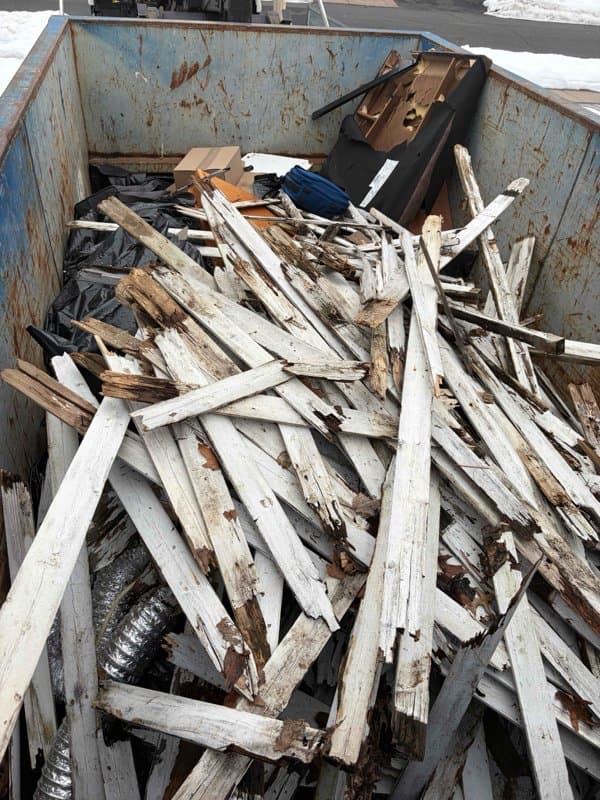
Wood goes the other direction. Decades-old stockade and picket is usually pressure-treated pine, often spongy with rot at the grade line, and it's straight disposal tonnage with no salvage story — treated lumber can't be burned, chipped, or mulched, so don't let anyone talk you into leaving it for firewood. Vinyl is the bulk problem: light but voluminous, and brittle enough in a Connecticut January that cold-weather removals get bundled and handled with more care than the material probably deserves.
Everything fence-adjacent can ride out too — gates, hardware, the roll of spare fabric that's been leaning in the garage since the fence went in. What stays behind: dirt and concrete beyond what comes up on a pulled post. If a run has a poured curb or footing wall under it, that's clean-fill territory and we'll point you at the right kind of hauler rather than pretend our cans do that work. You don't have to care about any of this sorting — it's all inside the fixed total — but it's why two fences of identical length can carry different quotes.
Fence Removal in Fairfield County — questions we actually get
My fence is on the property line — anything I should do first?
Talk to the neighbor before we show up. We take direction from the person who hires us, but a shared-line fence coming down unannounced is a neighbor dispute we can't fix from the truck.
Do fence posts come out of the ground?
Where they'll pull, they pull — concrete plug and all if it comes up whole. Where a post snaps or the plug won't budge, we cut at grade and tell you which ones stayed. Full plug excavation on a long run is dig work we'll quote honestly rather than pretend it's included.
Wood versus chain-link versus vinyl — which is harder?
Chain-link is fastest — fabric rolls up, rails unbolt. Vinyl comes apart clean but bulks up the load. Old wood stockade is the heaviest and the most likely to fight, especially where posts have rotted at grade and the run is leaning.
Can you remove just a section of fence?
Yes. Partial runs, one bad stretch, the back line only — the quote follows the footage and the material, not a minimum fence count.
Is there anything you won't take with the fence?
Dirt and concrete beyond what rides out on a pulled post. If a run has poured curb or footing wall under it, that's clean-fill territory and we'll point you at the right kind of hauler for it.
Why can't your trucks just take the Merritt?
Because the parkway bans commercial vehicles — it's a hard rule, not a preference, and every hauler working this county lives with it. Our trucks run I-95 or come down Route 7 or Route 8 instead. It's already baked into our Fairfield County scheduling, so it doesn't change your quote or your booking window; it's just why the truck arrives from the direction it does.
The fence between us and the neighbor is falling down and nobody remembers who built it. Now what?
Talk first, then call us. A boundary fence with unclear ownership is a conversation — or occasionally a property survey — between you and the neighbor, and it has to happen before removal, because we can't referee it from the truck. The good news: in our experience most neighbors are delighted to split the cost of removing an eyesore both of them have been staring at. Once you're agreed, the removal itself is routine.
Fairfield County towns we serve
StamfordGreenwichDarienNew CanaanNorwalkWestportWiltonFairfieldTrumbullEastonWestonMonroeRidgefieldBethelDanburyBrookfieldBridgeportStratfordSheltonNewtownReddingNew FairfieldSherman
Drive times from our yard run ~30–75 min across the county.
More in Fairfield County
- Hot Tub Removal in Fairfield County
- Shed Removal in Fairfield County
- Above-Ground Pool Removal in Fairfield County
- Deck Removal in Fairfield County
- Garage Demolition in Fairfield County
- House Demolition in Fairfield County
- In-Ground Pool Removal in Fairfield County
- Dumpster rental in Fairfield County
- Fence Removal across Connecticut
- All demolition & removal services
Ready to book your delivery?
Same-day delivery when you call before 11 AM. Trucks dispatch Mon–Sat 8 AM – 4 PM (best-effort scheduling for earlier or later requests). Phones answered 8 AM – 10 PM, 7 days; live team Mon–Fri 8 AM – 4 PM, AI phone assistant other times.