Family-owned since 2014 · 4.99 ★ × 463 reviews · 20,000+ jobs
Basement Cleanouts in Connecticut
Wet basement, water-damaged stuff, decades of storage. We get it out, all the way up the stairs, into our truck.
20,000+
jobs completed
4.99 ★
463 reviews
Family-owned
since 2014 (12 years)
Licensed & insured
in Connecticut & New York
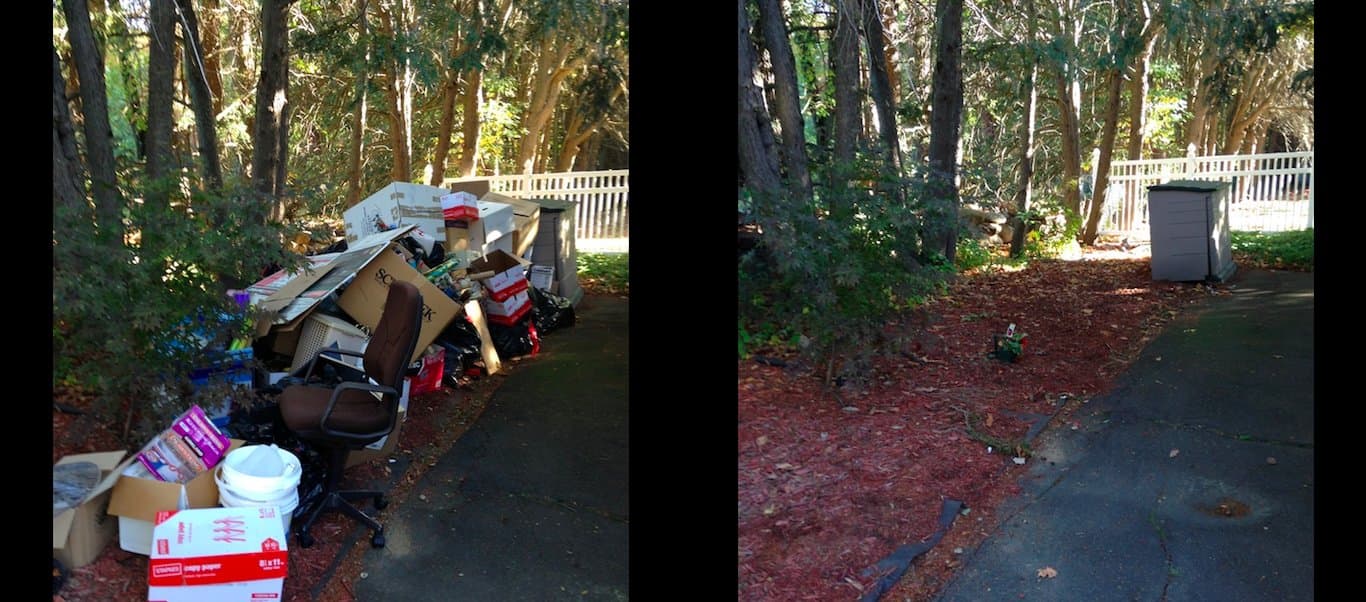
Basements collect everything. Decades of stored stuff. Water-damaged furniture from the last storm. The boxes you packed when you moved in twenty years ago and never opened. The exercise equipment from the year you joined a gym. The old appliances "in case we need them."
We do basement cleanouts year-round, but the volume spikes after major weather events. Late summer hurricanes. Spring melt floods. Fall basement-water surprises when nobody noticed the sump pump died. Whatever drove you to call — we'll get it out, all the way up the stairs, into our truck.
Who this is for
- Post-water-damage homeowners clearing soaked furniture and ruined storage
- Estate cleanouts where the basement is the biggest single overload area
- Downsizers clearing decades of "I'll deal with it later" storage
- New homebuyers who inherited a basement-full from the prior owner
- Pre-listing prep — basements often photograph badly because they're packed
If you're calling after a flood, call early — same-day works when capacity exists.
What we do
- Walk the basement. Crew lead with you. You point at what stays (some basements have shelving and storage you're keeping); we plan what goes.
- Stair-carry. Two- or three-person crew, depending on volume. We carry up; you don't.
- Sort at the curb. Donatable items (working furniture, clean clothing) routed to charity. Everything else hauled.
- Hazmat triage. Anything we can't take (paint, chemicals, batteries) gets flagged with a disposal-channel recommendation.
- Mold awareness. We'll tell you if we see active mold growth or suspected asbestos. We're not remediation specialists — but we'll alert you so you can call the right specialist before further work.
- Broom-sweep finish. Concrete floor swept. Easier to see what's left.
After a flood
A few patterns we see in post-flood basement cleanouts:
- Speed matters. Wet drywall and wood products mold within 24-48 hours. Soaked items routed to disposal early prevent secondary mold problems in the basement.
- Take the photos first. If you're filing an insurance claim, photograph everything before we haul. Some insurance adjusters want to see the damaged items before they're disposed of.
- Drywall and insulation that got wet should come out. They don't dry effectively in a finished basement; mold establishes in the wall cavity. Standard practice for water-damage restoration is removing the bottom 12-24 inches of wet drywall plus the insulation behind it.
- Carpet that got wet usually doesn't come back. Some carpets can be saved with professional water extraction; most can't.
For active major flooding or mold remediation work, the cleanout is downstream of the remediation specialist. We come in after the abatement is done to clear the dead material.
Junk removal — truck-space pricing (basement cleanout standard)
When loading the dumpster yourself isn’t the right call — small volume, awkward access, or you just want it gone today — we send a crew. Pricing runs by truck space used, not by item. Final pricing confirmed before removal begins.
- Minimum Load$179
- 1/8 Truckload$239
- 1/6 Truckload$309
- 1/4 Truckload (~5 yd³)$359
- 1/3 Truckload$419
- 3/8 Truckload$489
- 1/2 Truckload (~10 yd³)$559
- 5/8 Truckload$659
- 2/3 Truckload$759
- 3/4 Truckload (~15 yd³)$809
- 5/6 Truckload$849
- 7/8 Truckload$919
- Full Truckload (~20 yd³)$979
Not sure which tier? Send a few photos and we’ll size it for you.
Get a Free Junk Removal QuotePricing for basement cleanouts
Junk-removal pricing — truck-space used at the end of the job. Typical ranges:
- Partial basement cleanout (one corner, post-flood, single project): $359-$659
- Standard basement full cleanout: $659-$1,700
- Hoarder-condition or heavy water-damage cleanout: $1,700-$3,900+ across one or two visits
- Whole-home cleanouts including the basement: see Whole-Home Cleanouts
Stair-carry included at all tiers. Heavy water-damaged items hit the weight side of the math — if the truck is dense with soaked boxes and wet carpet, we'll size accordingly.
Rather do the carrying yourself? The rent-a-can version of this job is on our basement cleanout dumpster page — with the honest caveat that basement debris, especially anything water has touched, is some of the densest material in residential hauling. Our real load data shows how fast dense loads eat a can's weight allowance; crew loading makes the weight our problem instead of yours. For texture on what the crew actually hauls: mattresses and box springs turned up on 18% of our itemized 2026 Fairfield County junk jobs (a thin n=45 sample — texture, not a rate card).
What we don't do
- Mold remediation. We haul. Active mold growth needs a remediation specialist first. We can come after.
- Asbestos abatement. Specialized hauler required. We work around suspected asbestos, not through it.
- Heating oil tank removal. Specialized contractor required. We can't haul old oil tanks.
- Structural drying. That's a water-damage restoration company's job. We come after to clear the dead material.
- Insurance adjusting. We document what we haul; insurance is the homeowner's process with their carrier.
Why us
- Stair-carry included. No surprise "long carry surcharge" after the truck shows up.
- Operator voice. Tier range on the call, final tier on site, no bait-and-switch.
- Mold + asbestos honest. We'll tell you when the right call is a specialist before we start.
- 20,000+ jobs since 2014. Basement work — including post-flood — is regular dispatch.
- Family-owned. Same crew, same phone number. Our own team checks email every day — no call center.
Basement cleanout FAQs
Do you charge extra for stair-carry?
No — stair-carry is included. Most basement cleanouts mean a flight of stairs to ground level, and that's built into the truck-space pricing. We're not a "long carry surcharge" hauler; it doesn't change how much truck your stuff takes.
Can you handle water-damaged items?
Yes — water-damaged furniture, soaked boxes, ruined carpet, warped wood, moldy soft goods. All standard basement-cleanout content. Wet items are heavier per cubic yard than dry items; we factor that into the tier estimate when we walk it.
What if there's mold?
We'll tell you if we see it. We're not mold remediation specialists — for active mold growth (visible black mold, musty smell throughout, water still present), the right call is a mold-remediation company first. We can come back after remediation to clear the residual material. For light surface mold on disposable items (boxes, fabric, soaked cardboard), we'll handle it with masks and gloves.
Do you handle asbestos pipe wrap or boiler insulation?
No — asbestos requires a specialized abatement contractor. Old CT homes (pre-1980) sometimes have asbestos pipe wrap, vermiculite attic insulation, or 9x9 floor tile from the 1950s-70s. If we see suspected asbestos, we'll flag it and recommend you get a sample tested before any further work. We work around it, not through it.
Can you do same-day for a basement emergency?
If we have capacity and you're in our same-day service area, yes. Most flood-damage cleanouts have a 24-72 hour urgency window — call as early as possible. Phones answered 8 AM – 10 PM, 7 days; live team Mon–Fri 8 AM – 4 PM, AI phone assistant other times.
What can't you take?
Standard exclusions: paint and chemicals (route through CT DEEP hazwaste), batteries, asbestos-containing materials, liquids, medical waste, large propane tanks. Heating oil tanks and old fuel tanks need specialized removal — we don't do those.
Will you take the old basement freezer / fridge / water heater?
Yes. Refrigerators and freezers come with a $50 CFC handling fee (pass-through from the transfer station). Water heaters and washers/dryers are fine in the truck — no special fee.
Related pages
- For Homeowners overview
- Garage Cleanouts — the next project after the basement
- Attic Cleanouts — same job, opposite end of the house
- Hoarding Cleanouts — when scope is multi-day, multi-truck
- Whole-Home Cleanouts — full-property scope
- Junk Removal — service deep-dive
What's actually down there
The pattern repeats house to house across Connecticut, and knowing it up front makes the estimate closer:
- Furniture that got demoted. The sofa that moved down when the new one arrived, then never moved again.
- Boxes from a previous move. Frequently sealed, frequently unopened since — and the single most common thing people ask us to set aside rather than load.
- Exercise equipment. Treadmills and weight benches are heavy, awkward, and rarely fit back up the stairs in one piece.
- Old appliances. A retired fridge or freezer kept "in case" — these carry a $50 pass-through for CFC recovery, and doors come off before transport.
- Paint and chemicals on a shelf. Almost always present, almost never disposable in a general load.
- Water-damaged everything. In a basement that has flooded even once, the bottom layer weighs more than it looks.
Crew or can: the weight math
The honest decision here isn't about price, it's about who does the carrying and what the material weighs.
A crew makes sense when the carry is the problem. Stairs, a hatch, a long walk to the driveway, or anything you can't physically move alone. You pay for truck space and we do all of it — $179 for a minimum load through $979 for a full 20-yard truck.
A can makes sense when the material is heavy and the pace is slow. A roll-off sits on the driveway for 7 days and you fill it whenever you have an hour. A 10-yard at $447 includes 1,000 lbs; the 20-yard at $647 includes 4,000 lbs. Past the allowance it's $0.1/lb, billed at the transfer-station rate rather than marked up.
Where the weight math bites. Household contents are light and bulky — furniture, boxes, bags — so a crew job usually fills the truck long before it troubles a weight cap. Wet material is the opposite. Water-damaged carpet, soaked cardboard, plaster and anything that has sat in standing water can run two to three times its dry weight, which is how a half-full can ends up over its allowance. If the material is wet, say so when you book and we'll size for weight rather than volume.
What can't go, wherever it's going
Some things don't ride in a truck or a can regardless of who's loading:
- Paint, solvents, fuel, pool chemicals, pesticides. Household hazardous waste goes to a municipal collection event or a designated facility. Dried-out latex paint with the lid off is usually fine as ordinary waste — check your town's rule.
- Propane tanks and pressurised cylinders. Many Connecticut transfer stations now take these free through cylinder-recycling programmes.
- Tires, car batteries, motor oil. Accepted at most town facilities, frequently free, but not in a general load.
- Asbestos-containing material. Old pipe wrap, some floor tile, certain siding. Licensed abatement first, always — we stop and tell you rather than load it.
- Concrete, brick, dirt, sod, rock and stumps. Neither a bag nor a standard can takes these; they need a dedicated heavy-material hauler.
The full reference is what can and can't go in a dumpster; the town-by-town municipal rules are in the Connecticut transfer station guide.
Town-level pages
Basement work is one of the two most common cleanout calls we take, and it looks different town to town depending on what the local transfer station will accept.
- Junk removal by town — Stamford · Norwalk · Danbury · Glastonbury · West Hartford · Branford · Old Saybrook
- Estate cleanouts by town — Greenwich · Westport · Simsbury · Essex
- Same-day, by county — Fairfield · New Haven · Hartford · Middlesex
Book a basement cleanout
Call (203) 219-8855, 8 AM – 10 PM, 7 days; live team Mon–Fri 8 AM – 4 PM, AI phone assistant other times. Post-flood calls — call as early as possible; we prioritize urgency where capacity allows.