Grizzly Junk Pros · Family-owned since 2014 · 4.99 ★ × 463 reviews · 20,000+ jobs
Garage Demolition in Fairfield County, CT
On lots this valuable, a failing garage is ground worth getting back — the teardown coordinated through our licensed demolition partner, every load of debris out in our own dumpsters.
In Fairfield County, the math on a failing detached garage is different than anywhere else we work. Land here carries the highest property values in the state, and the footprint under a sagging one-car garage — usually parked right against the lot line by whoever built it generations back — is ground worth reclaiming. Owners take one down for the parking pad, for the garden, for the yard their kids actually use, or simply because the structure has become the thing the home inspector and the insurance carrier both keep mentioning.
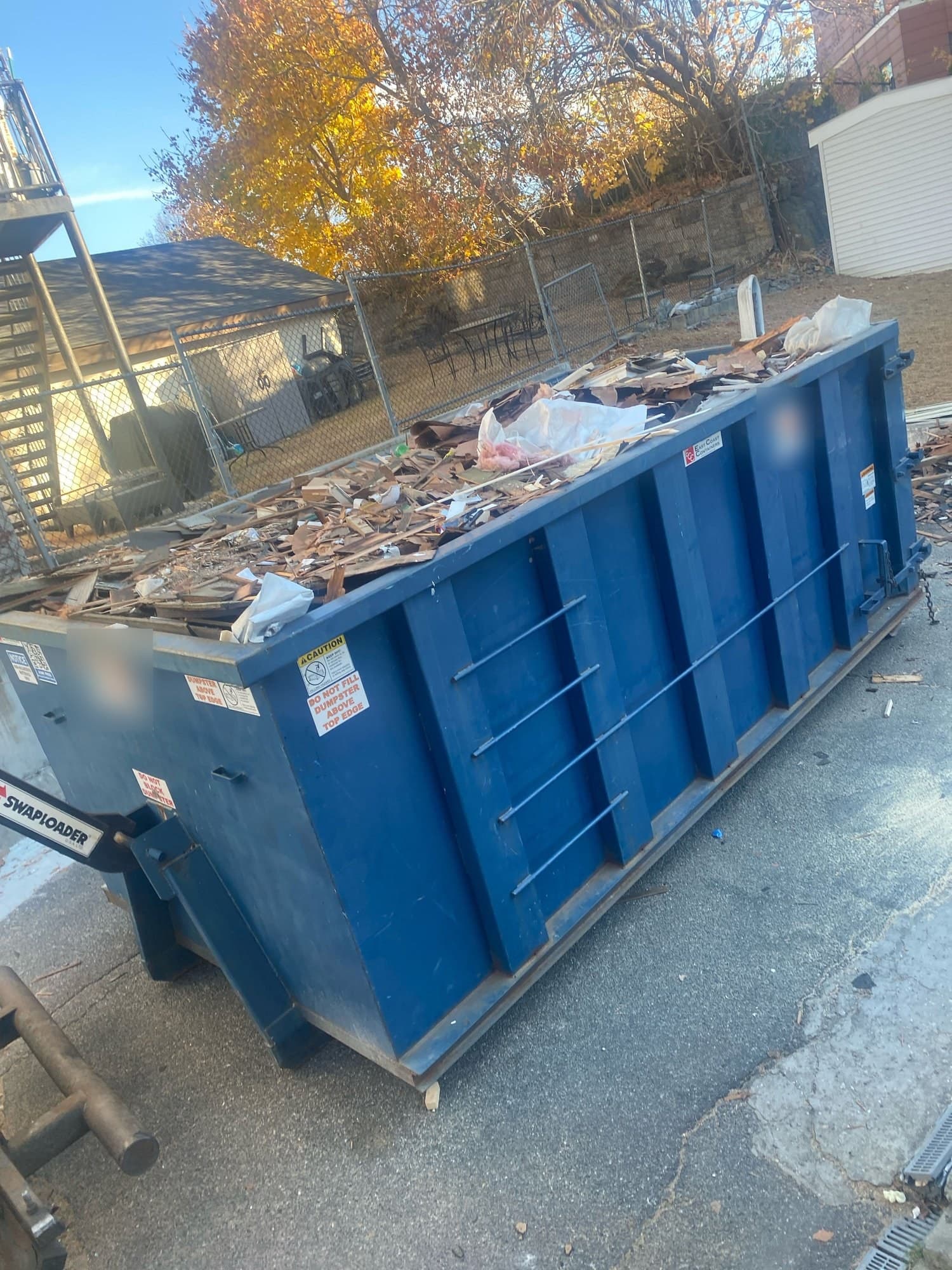
Who does what is worth stating plainly on a project this size. Grizzly does not perform the teardown: the demolition is coordinated through our licensed demolition partner, who walks the structure, quotes the work, and contracts it with you directly. What Grizzly runs end to end is the debris — every load of it out in our own dumpsters at posted rates.
Lot-line garages are exactly why the walk matters here. A structure standing three feet from a neighbor's fence is a scoping question before it's a demolition question, and it gets answered on the property rather than over the phone. The slab stays and becomes whatever the reclaimed ground wants to be.
Utilities dead, permit confirmed, then the demolition
Garage demolition is mostly sequencing, and the teardown is the last act rather than the first. Act one: the electrical. Most detached garages carry at least one circuit from the house — lights, an opener, sometimes a subpanel that fed someone's workshop ambitions decades ago — and that feed must be disconnected and made safe at the source by a licensed electrician before a demolition date exists on the calendar. Not taped off in the garage; dead at the panel, confirmed rather than assumed. Same rule for any water or gas line that ever crossed the yard.
Act two: the permit. A detached garage is the accessory structure most likely to need a demolition permit — it's a real building in every Connecticut building department's eyes. The permit sequence rides inside the partner's contracting process, and one call to your building department settles what your address needs.
Act three: the demolition itself, performed by our licensed demolition partner on a schedule they set after the site walk. Grizzly's cans follow that schedule — placed before the first demolition day, swapped as they fill, hauled at posted rates. The demolition drives the container plan, never the reverse, so the site never sits buried waiting on an empty box.
Tight streets, no Merritt, careful staging
Fairfield County container work starts with the county's standing routing rule: the Merritt Parkway prohibits commercial vehicles, so our trucks and roll-offs arrive via I-95 or Route 7 and Route 8. The county runs roughly 30–75 minutes from our Stamford and West Haven yards, and the routing is our problem to plan, not yours.
The real access story is on your block. Garages here sit at the end of narrow driveways on tight streets, and a garage's worth of debris is real tonnage — so the site walk settles where a can can live for the demolition days, and whether the driveway carries the load path or the debris travels by hand. Tell us about parking rules on your street at intake and the container plan gets built around them, alongside the partner's own staging plan.
Why this page has no price grid
A detached garage is a real building — footprint on the town's records, a roof carrying two or three generations of shingles, a slab underneath — and it is quoted per property by our licensed demolition partner, the contractor who walks the structure, scopes the teardown, and contracts it with you directly under their own license. Roof layers, interior finish, lofts, lean-tos, block half-walls, and lot lines move that number too much for a grid to be honest about it. Request a demolition quote and one intake scopes both halves of the project.
The half Grizzly prices openly is the debris. Here's the structural fact behind the whole arrangement: demolition contractors rent their roll-off containers from someone. Grizzly owns a hundred identical cans, staged out of two Connecticut yards and dispatched by the same people who answer the first call. Debris volume is the part of a garage project Grizzly controls end to end, and it moves at the same posted rates every dumpster customer on this site sees.
That split is worth more on a garage than on almost anything else, because a garage is mostly tonnage once it's down. Asphalt roofing weighs far more than its area suggests, a doubled-up roof means two roofs' worth of weight, and plaster interiors carry more than their footprint hints at. You end up with two clean numbers instead of one blended one — the teardown from the contractor who performs it, the debris from the fleet that hauls it. Clearing the contents first is Grizzly's own junk-removal service, quoted by volume, and it makes the partner's walk-through more accurate.
Everything above the slab goes — the slab itself stays
The structure comes off the pad: walls, roof, framing, doors and tracks, sill plates, anchor hardware cut flush. What rides out in Grizzly's own dumpsters is the mixed construction stream that follows — framing, sheathing, siding, interior finish, and the roofing that made up most of the weight — hauled to state-permitted Connecticut transfer stations. Metal earns its keep along the way: garage doors, tracks, opener rails, and steel roofing get pulled aside for scrap recycling instead of paid disposal weight.
The slab is the firm line. Concrete never rides in our cans, and it stays put unless slab removal is written into the partner's scope — broken pad is dense clean-fill material with its own stream and its own hauler. A bare pad is rarely a problem anyway; it becomes the parking spot, the basketball half-court, the base for whatever replaces the garage. If bare ground is genuinely the goal, say so at intake so the concrete phase gets sequenced after the structure is gone, when the site is open and the work costs less.
Two more lines, stated plainly. Contents are Grizzly's own junk-removal service, quoted by volume and usually cleared before demolition day — but paint, oil, and fuel route through your town's hazardous-waste program rather than any truck of ours. And pre-1980 garages occasionally wear asbestos-cement siding or shingles; where suspect material turns up, licensed abatement comes first, and abatement waste never rides in a standard C&D can.
Garage Demolition in Fairfield County — questions we actually get
The garage still has electricity — is that a problem?
It has to be dead before demolition starts — disconnected at the panel by a licensed electrician, not just switched off at the garage. Most detached garages are fed from the house panel by a buried or overhead run, and that disconnect gets confirmed, never assumed. Same rule for any water or gas line that ever crossed the yard.
Does Grizzly take the garage down?
No, and we'd rather say it plainly than blur it. A detached garage is a real building, and the teardown is coordinated through our licensed demolition partner — a licensed, insured demolition contractor who walks the structure, quotes the work, and contracts it with you directly. What Grizzly runs end to end is the debris: every load goes out in our own dumpsters at the same posted rates every customer on this site sees.
What about the slab?
The structure goes; the slab stays unless slab removal is written into the partner's scope. Concrete never rides in Grizzly's cans — broken slab is dense clean-fill material with its own stream and its own hauler. Most owners keep the pad as parking, a patio base, or the footprint for whatever replaces the garage.
Do I need a permit to demolish a detached garage?
Almost always yes — a detached garage is the accessory structure most likely to need a demolition permit, because every CT building department treats it as a real building on the records. The permit sequence is part of what the partner walks you through as they contract the job, and one call to your building department settles what your address needs.
The garage is packed to the rafters — do I have to empty it first?
No, and this part is squarely Grizzly's own work. Clearing the contents is junk removal, which our teams run every day — same visit or the day before, quoted by volume. Pull out what you're keeping and leave the rest. Paint, oil, and fuel are the exception: those route through your town's hazardous-waste program rather than any truck of ours.
The garage is two feet off the neighbor's fence — is that a problem?
It's a scoping question, and it's one of the reasons this work runs through a licensed demolition contractor rather than a hauler with a plan. A zero-setback structure gets read on the property: how it comes down away from the line, where the debris lands, whether any of it needs to be worked from inside the building. Our side of it is the container placement, planned in the same conversation. A courtesy heads-up to the neighbor about a couple of noisy days is the only diplomacy required of you.
We want the footprint back as yard, not a parking pad. What happens to the slab?
The slab stays unless slab removal is written into the partner's scope — concrete never rides in Grizzly's cans on any project. Wanting bare ground just means one more step in the right order: the structure comes off first, then the concrete phase runs on an open, easy-access site, which costs less than working around a standing building. Say so at intake and the sequence gets lined up before anything is scheduled.
Fairfield County towns we serve
StamfordGreenwichDarienNew CanaanNorwalkWestportWiltonFairfieldTrumbullEastonWestonMonroeRidgefieldBethelDanburyBrookfieldBridgeportStratfordSheltonNewtownReddingNew FairfieldSherman
Drive times from our yard run ~30–75 min across the county.
More in Fairfield County
- Hot Tub Removal in Fairfield County
- Shed Removal in Fairfield County
- Above-Ground Pool Removal in Fairfield County
- Deck Removal in Fairfield County
- Fence Removal in Fairfield County
- House Demolition in Fairfield County
- In-Ground Pool Removal in Fairfield County
- Dumpster rental in Fairfield County
- Garage Demolition across Connecticut
- All demolition & removal services
Ready to book your delivery?
Same-day delivery when you call before 11 AM. Trucks dispatch Mon–Sat 8 AM – 4 PM (best-effort scheduling for earlier or later requests). Phones answered 8 AM – 10 PM, 7 days; live team Mon–Fri 8 AM – 4 PM, AI phone assistant other times.