Grizzly Junk Pros · Family-owned since 2014 · 4.99 ★ × 463 reviews · 20,000+ jobs
Garage Demolition in Bridgeport, CT
On lots this valuable, a failing garage is ground worth getting back — the teardown coordinated through our licensed demolition partner, every load of debris out in our own dumpsters.
In Bridgeport, this work runs from Brick Yard out to South End and Downtown.
A garage carries more hidden variables than almost anything else on a residential lot, so the demolition gets quoted on the property by our licensed demolition partner rather than off a grid, while the debris bills at the posted rates our own dumpsters always carry. Plaster interiors, doubled roof layers, a lean-to addition, contents stacked to the rafters — each one moves the tonnage, and tonnage is what the container math actually runs on. As the structure comes apart, doors, tracks, and metal roofing sort out for scrap recycling and the rest hauls to state-permitted transfer stations in our own trucks. The pad stays behind: reclaimed ground on a street where ground is worth plenty.
Tight streets, no Merritt, careful staging
Fairfield County container work starts with the county's standing routing rule: the Merritt Parkway prohibits commercial vehicles, so our trucks and roll-offs arrive via I-95 or Route 7 and Route 8. The county runs roughly 30–75 minutes from our Stamford and West Haven yards, and the routing is our problem to plan, not yours.
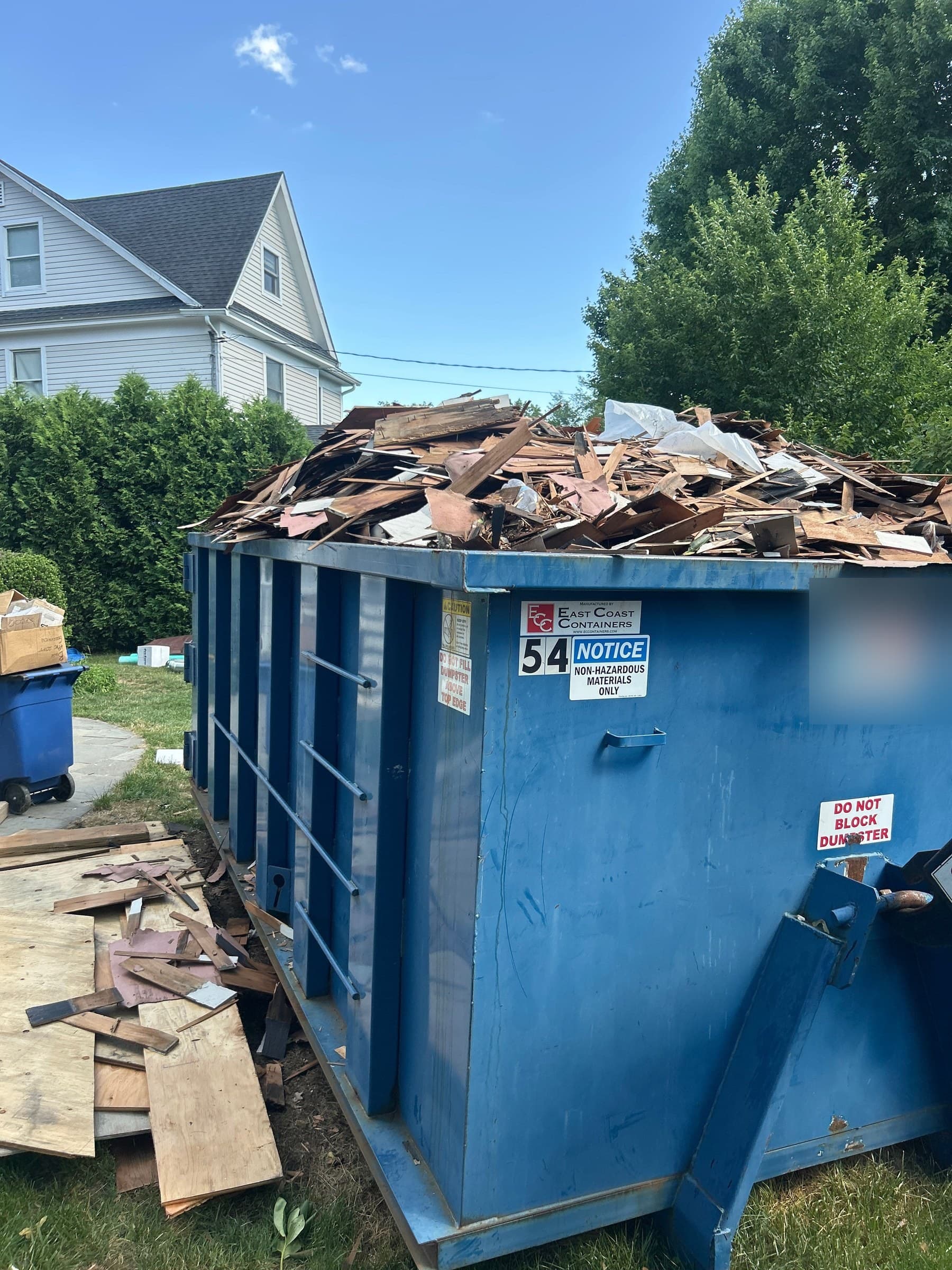
The real access story is on your block. Garages here sit at the end of narrow driveways on tight streets, and a garage's worth of debris is real tonnage — so the site walk settles where a can can live for the demolition days, and whether the driveway carries the load path or the debris travels by hand. Tell us about parking rules on your street at intake and the container plan gets built around them, alongside the partner's own staging plan.
What we take
The partner scopes the structure; our fleet moves everything above the slab, with doors, tracks, and metal roofing pulled for scrap and the concrete left in place.
How the job goes
Power made dead at the panel, permit confirmed, then the partner's demolition — with our cans placed and swapped on that schedule.
Where Bridgeport’s debris actually goes
Bridgeport’s own station doesn’t take this debris stream source — the DIY route means finding a private C&D facility on your own. On our jobs it’s not your problem: the debris rides out in our own cans to a private facility, weighed and billed at our posted rates.
What it costs
Detached garages are quoted per property by our licensed demolition partner, who contracts the teardown directly; the debris line runs on Grizzly's posted dumpster rates.
Disposal and permits in Bridgeport — from the town’s own pages
Bridgeport’s posted disposal point: Transfer Station (City of Bridgeport, Public Facilities) source at 475 Asylum Street, Bridgeport, CT 06610 source, with the posted schedule source in the questions below. It does not accept construction and demolition debris source — on our jobs that stream rides out in our own cans to a private C&D facility instead. No station permit program is published source.
Permits run through the Bridgeport building department at 45 Lyon Terrace, Room 222, Bridgeport, CT 06604 (Monday-Friday: 7:00 am-4:00 pm) source, 203-576-7225 source (department page).
A demolition permit is required for structure teardowns here source. The town publishes its demolition requirements — including any review or delay process for older structures — on its own page.
For furniture-scale material: Household Bulk Pickup Program — the city's page states the curbside program 'has officially ended' (2024 program); Bridgeport residents now bring household bulk items directly to the Transfer Station at 475 Asylum Street (Mon-Sat 7 am-3 pm); 'Items left on the sidewalk will no longer be collected and may result in fines'; contact (203) 576-7725. Transfer Station rules: all metals separated; wood doors and mattresses cut in half; max 2 tires per trip. source (program info)
Garage Demolition in Bridgeport — questions we actually get
Do I need a permit to demolish a detached garage?
Almost always yes — a detached garage is the accessory structure most likely to need a demolition permit, because every CT building department treats it as a real building on the records. The permit sequence is part of what the partner walks you through as they contract the job, and one call to your building department settles what your address needs.
Why route a garage demolition through a dumpster company?
Because debris is most of a garage job's logistics, and it's the half we own outright. Demolition contractors rent their roll-offs from someone; Grizzly owns a hundred, staged out of two Connecticut yards. One call sets up the partner's teardown quote and the container pipeline at once, and you get two clean numbers instead of one blended one.
The garage is packed to the rafters — do I have to empty it first?
No, and this part is squarely Grizzly's own work. Clearing the contents is junk removal, which our teams run every day — same visit or the day before, quoted by volume. Pull out what you're keeping and leave the rest. Paint, oil, and fuel are the exception: those route through your town's hazardous-waste program rather than any truck of ours.
The garage sits right on the property line — is that an issue?
It's a conversation before it's an issue. Tell the neighbor it's coming down: staging on a zero-setback garage sometimes means asking to work from their side, and that lands better as a request from you than a surprise from a contractor. Tight lot lines are exactly the kind of constraint the partner's site walk exists to settle, and can placement gets planned in the same conversation.
What makes a garage demolition cost more?
Second stories and packed contents, mostly. A garage with a loft adds nearly another structure's worth of framing and debris. Shingle layers matter too — a roof carrying two or three generations of asphalt weighs far more than most people guess, and weight is what the disposal side runs on. Access for can placement rounds out the list.
The garage is two feet off the neighbor's fence — is that a problem?
It's a scoping question, and it's one of the reasons this work runs through a licensed demolition contractor rather than a hauler with a plan. A zero-setback structure gets read on the property: how it comes down away from the line, where the debris lands, whether any of it needs to be worked from inside the building. Our side of it is the container placement, planned in the same conversation. A courtesy heads-up to the neighbor about a couple of noisy days is the only diplomacy required of you.
We want the footprint back as yard, not a parking pad. What happens to the slab?
The slab stays unless slab removal is written into the partner's scope — concrete never rides in Grizzly's cans on any project. Wanting bare ground just means one more step in the right order: the structure comes off first, then the concrete phase runs on an open, easy-access site, which costs less than working around a standing building. Say so at intake and the sequence gets lined up before anything is scheduled.
Can I take garage demolition debris to the Bridgeport transfer station myself?
No — Bridgeport's station doesn't accept construction and demolition debris, per the town's own published materials list. The DIY route means a private C&D facility; on our jobs the debris leaves in our own cans and that problem never reaches you.
Do I need a permit to use the Bridgeport transfer station?
Bridgeport publishes no resident permit program for its station — proof of residency is the posted requirement. Rules change, so check the town's page before loading a truck.
When is the Bridgeport transfer station open?
The town posts (as published September 2026): Monday to Saturday from 7:00 am to 3:00 pm (closed Labor Day). Holiday closures apply — check the town's page before you load, or skip the trip entirely and let the can take the schedule problem off your plate.
Nearby towns we serve
Same trucks, same rates — the Bridgeport routes share dispatch with the towns next door. No zone pricing anywhere in our service area.
- Garage work over in Fairfield
- Garage demolition in Trumbull
- Stratford detached-garage tear-downs
- Taking garages down in Shelton
Full county coverage, town by town: garage demolition across Fairfield County.
More removal in Bridgeport
Ready to book your delivery?
Same-day delivery when you call before 11 AM. Trucks dispatch Mon–Sat 8 AM – 4 PM (best-effort scheduling for earlier or later requests). Phones answered 8 AM – 10 PM, 7 days; live team Mon–Fri 8 AM – 4 PM, AI phone assistant other times.