Grizzly Junk Pros · Family-owned since 2014 · 4.99 ★ × 463 reviews · 20,000+ jobs
In-Ground Pool Removal in Bridgeport, CT
In-ground pool demolition coordinated through our licensed demolition partner — the excavation is theirs, and the debris goes out in our own dumpsters.
In Bridgeport, this work runs from North End out to West End and South End.
What an in-ground removal costs is mostly buried — shell material, access for equipment, how much fill the hole takes — so the excavation gets quoted on site, through our licensed demolition partner, never off a grid. The visible half of the price is ours: debris in our own dumpsters at the rates posted across this site. That split protects you in a specific way on a project like this. On a partial removal the partner often reuses broken shell as engineered fill down in the hole, part of why partial quotes lower — and because the fill decision is the partner's scope while the can count is our posted math, you can see which choice moves which number.
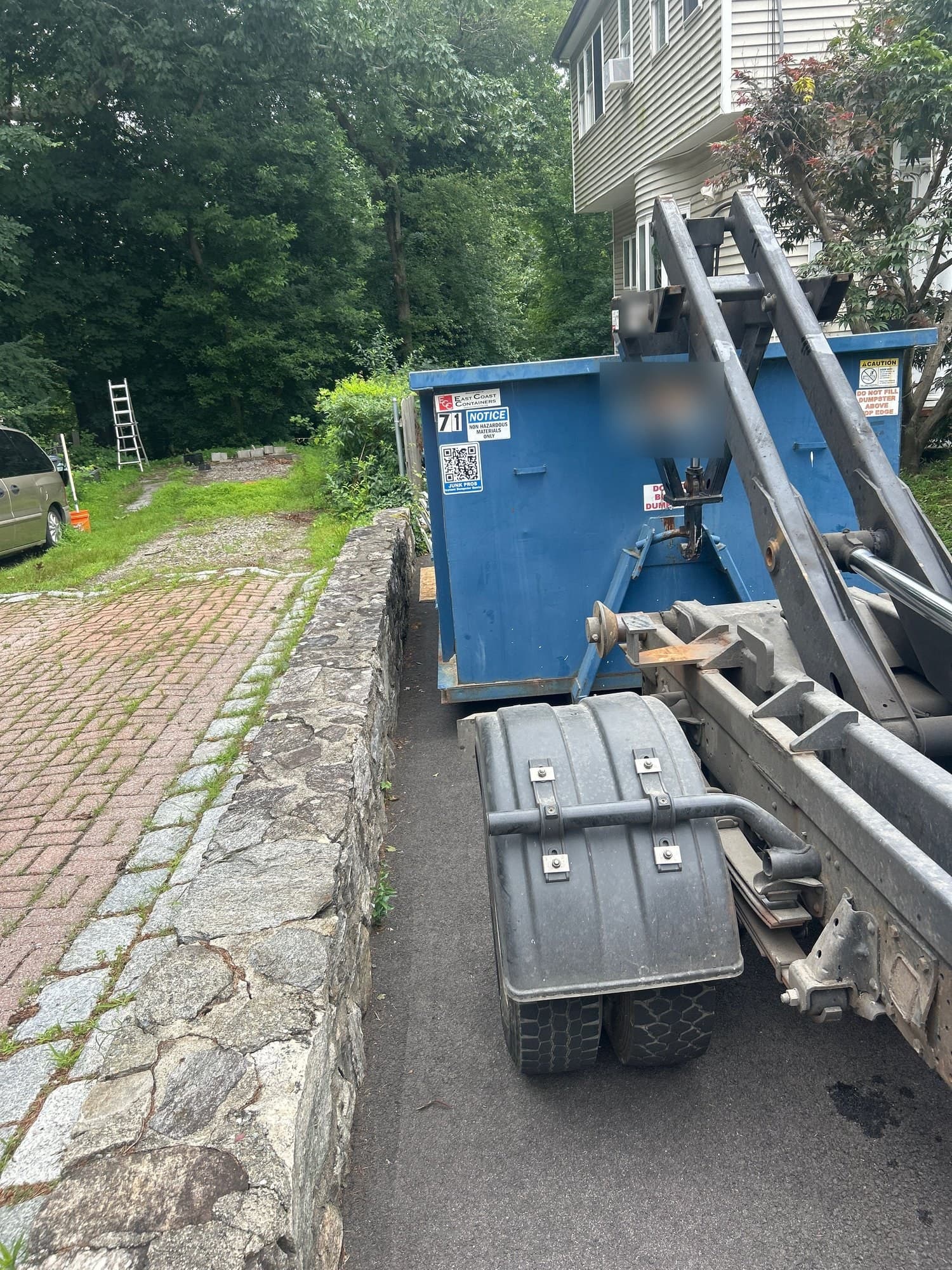
How the job goes
The partner breaks or removes the shell and manages fill and compaction; our cans handle the surface debris around that plan.
What we take
Decking tear-out, equipment, and fencing move in our cans; the shell and fill belong to the partner's excavation scope, never our containers.
Where Bridgeport’s debris actually goes
Bridgeport’s own station doesn’t take this debris stream source — the DIY route means finding a private C&D facility on your own. On our jobs it’s not your problem: the debris rides out in our own cans to a private facility, weighed and billed at our posted rates.
What it costs
In-ground pool work is quoted per project by our licensed demolition partner — partial fill versus full removal drives the number, and the debris rides at Grizzly's posted rates.
Pool debris on a tight Fairfield County lot
The pool is in the backyard; the can lives in the front. On this county's dense suburban lots, that gap — the wheelbarrow-and-machine path between where decking gets broken and where debris gets loaded — is the logistics conversation, and the partner's walk settles it alongside can placement before anything is scheduled.
Routing follows the county's one hard rule: the Merritt Parkway prohibits commercial vehicles, so cans arrive by I-95 or Route 7 and Route 8, about 30–75 minutes from our West Haven yard depending on the town. Pool-adjacent debris runs heavy — wet decking, tile, waterlogged equipment — so swaps get planned around weight as much as volume, and the math is stated before the dig starts.
Disposal and permits in Bridgeport — from the town’s own pages
Bridgeport’s posted disposal point: Transfer Station (City of Bridgeport, Public Facilities) source at 475 Asylum Street, Bridgeport, CT 06610 source, with the posted schedule source in the questions below. It does not accept construction and demolition debris source — on our jobs that stream rides out in our own cans to a private C&D facility instead. No station permit program is published source.
Permits run through the Bridgeport building department at 45 Lyon Terrace, Room 222, Bridgeport, CT 06604 (Monday-Friday: 7:00 am-4:00 pm) source, 203-576-7225 source (department page).
A demolition permit is required for structure teardowns here source. The town publishes its demolition requirements — including any review or delay process for older structures — on its own page.
For furniture-scale material: Household Bulk Pickup Program — the city's page states the curbside program 'has officially ended' (2024 program); Bridgeport residents now bring household bulk items directly to the Transfer Station at 475 Asylum Street (Mon-Sat 7 am-3 pm); 'Items left on the sidewalk will no longer be collected and may result in fines'; contact (203) 576-7725. Transfer Station rules: all metals separated; wood doors and mattresses cut in half; max 2 tires per trip. source (program info)
In-Ground Pool Removal in Bridgeport — questions we actually get
How long does an in-ground pool removal take?
Once permits are in hand, most fill-ins are measured in days — machine in, shell broken or removed per the scope, hole filled and compacted in lifts. The permit and scheduling runway in front of that is longer than the dig itself. The partner gives the working timeline when it scopes the property.
What does Grizzly's fleet actually do on a pool job?
The non-fill debris — decking tear-out where it's part of scope, equipment, fencing, and the C&D stream the excavation produces — moves in our cans at our posted rates. Clean concrete and fill routes the way the partner's excavation plan dictates.
Is there a season that works better for pool removal?
Drier ground helps — compaction is the whole game on a fill-in, and saturated soil compacts badly. That makes late summer and fall friendlier than mud season, though the partner schedules around ground conditions rather than the calendar. If the goal is lawn by summer, a fall removal gives the fill a winter to settle before seeding.
How does the machinery get to a backyard pool?
That's one of the first things the partner scopes on a walk-through. An excavator needs a path — commonly a fence section out and a run of protective mats across the yard. Some turf repair along the machine path is a normal part of any pool job, and it's worth asking the partner to spell out site restoration in the scope.
Anything I should handle before the work starts?
Know your yard. Where the septic and its leach field sit, where the well is, what's buried along the machine path — the partner needs all of it before an excavator moves. Keep the pool area secured until work begins, and decide early what happens to plantings in the access path. Everything else belongs to the scope.
Most pools around here are older gunite — does that change the removal?
It makes the project a demolition in the literal sense: a gunite shell has to be broken before anything gets filled, where a vinyl-liner pool gives up its liner and plumbing more easily. The partner scopes which route — partial fill-in or full shell removal — fits the property and what you plan to do with the yard. The broken-shell debris math is exactly why the dumpster side runs first-party here.
Can I take in-ground pool removal debris to the Bridgeport transfer station myself?
No — Bridgeport's station doesn't accept construction and demolition debris, per the town's own published materials list. The DIY route means a private C&D facility; on our jobs the debris leaves in our own cans and that problem never reaches you.
Do I need a permit to use the Bridgeport transfer station?
Bridgeport publishes no resident permit program for its station — proof of residency is the posted requirement. Rules change, so check the town's page before loading a truck.
When is the Bridgeport transfer station open?
The town posts (as published September 2026): Monday to Saturday from 7:00 am to 3:00 pm (closed Labor Day). Holiday closures apply — check the town's page before you load, or skip the trip entirely and let the can take the schedule problem off your plate.
Nearby towns we serve
Same trucks, same rates — the Bridgeport routes share dispatch with the towns next door. No zone pricing anywhere in our service area.
- Pool fill-in coordination in Fairfield
- In-ground pool removal in Trumbull
- Stratford pool fill-ins, coordinated
- In-ground pool demolition in Shelton
Full county coverage, town by town: in-ground pool removal across Fairfield County.
More removal in Bridgeport
Ready to book your delivery?
Same-day delivery when you call before 11 AM. Trucks dispatch Mon–Sat 8 AM – 4 PM (best-effort scheduling for earlier or later requests). Phones answered 8 AM – 10 PM, 7 days; live team Mon–Fri 8 AM – 4 PM, AI phone assistant other times.