Grizzly Junk Pros · Family-owned since 2014 · 4.99 ★ × 463 reviews · 20,000+ jobs
House Demolition in Greenwich, CT
Full teardowns on Fairfield County lots, coordinated through our licensed demolition partner — every load of debris goes out in our own dumpsters at posted rates.
In Greenwich, this work runs from Old Greenwich out to Glenville and Pemberwick.
Most of what comes down in this county is older coastal housing stock — capes, split-levels, additions that outlived their logic — and every teardown is scoped, quoted, and contracted through our licensed demolition partner, never by Grizzly. Our part is what the machine produces: framing, roofing, plaster, and the rest of the post-abatement C&D stream, hauled off in our own dumpsters at posted rates. Partial projects are normal here too — a fire-damaged wing, a failed addition, everything down to a foundation worth keeping — and the partner reads those options on the walk. Contents are junk removal, Grizzly's own trade; salvage worth pulling gets flagged before machine day so it's stacked, not loaded.
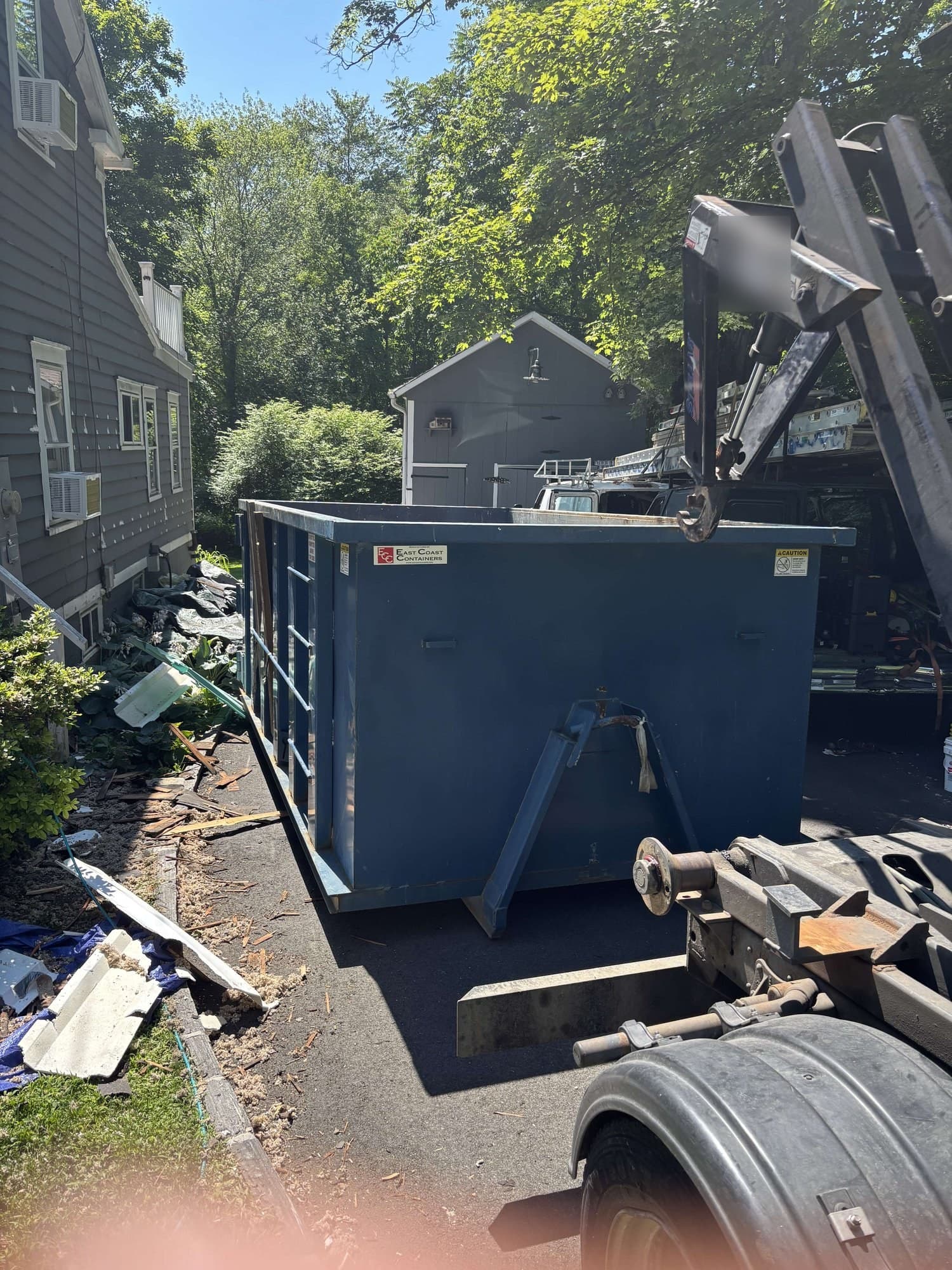
Fairfield County logistics, stated up front
One hard routing rule shapes every delivery in this county: the Merritt Parkway prohibits commercial vehicles, so our trucks never touch it. Cans reach Fairfield County jobs by I-95 or Route 7 and Route 8, and pickup windows get planned around that reality rather than around the shortest line on a map. Figure roughly 30–75 minutes from our West Haven yard depending on where in the county the lot sits.
The lots themselves are the other half of the plan. Dense streets and tight driveways mean the two-can teardown package often stages one can at a time, swapped as the machine works, instead of both side by side. The partner's machine plan and our container plan get set in the same conversation, so neither one discovers the driveway on delivery day.
What we take
The partner scopes the structure; our fleet moves the post-abatement debris stream, with metal pulled for scrap and clean fill routed by the excavation plan.
How the job goes
Permit, utility disconnects, asbestos survey, then the machines — the partner runs that sequence and our cans cycle on the demo schedule.
What it costs
Full teardowns are quoted per project by our licensed demolition partner, who contracts the demolition directly; the debris line runs on Grizzly's posted dumpster rates.
Where Greenwich’s debris actually goes
The do-it-yourself route exists here: Greenwich’s station takes C&D at a published per-ton rate source (quoted in full in the disposal questions below), resident permit required. Our route: the debris leaves in the can that’s already on the job, weighed once, billed at posted rates — no permit line, no pickup-truck trips, no guessing what the scale will say.
Disposal and permits in Greenwich — from the town’s own pages
Greenwich’s posted disposal point: Holly Hill Resource Recovery Facility source at 4 Holly Hill Lane source, with the posted schedule source in the questions below. It accepts construction and demolition debris source at the town’s published per-ton rate source, quoted in full in the disposal questions below. Station access requires a resident permit source (permit details).
Permits run through the Greenwich building department at 101 Field Point Road, Greenwich, CT 06830 source, 203-622-7700 source (department page).
A demolition permit is required for structure teardowns here source. The town publishes its demolition requirements — including any review or delay process for older structures — on its own page.
Our dumpsters in Greenwich
The demolition itself is partner-performed; the dumpsters and the disposal are Grizzly’s — and that’s the part Greenwich customers already know us for.
A “Friendly, professional, clean and courteous. Arrived on time and were efficient removing items. Reasonable value.”
A “Fast and professional! The crew was on time, easy to work with and got the job done fast and with great quality of service!”
A “Exc. Service. They were on time & had great pricing! Would highly recommend.”
House Demolition in Greenwich — questions we actually get
What has to happen before a house comes down?
A demolition permit from the town, utility disconnects confirmed by each utility, and — on older housing stock — an asbestos survey, with licensed abatement before demolition if the survey finds it. The partner walks the owner through that sequence as part of contracting; none of it is optional and none of it is skippable.
How many dumpsters does a house teardown generate?
House size, construction type, and how much gets stripped for salvage first all move the number — which is why loads are quoted per project at our posted rates rather than guessed here. The honest version of the math lives in our house demolition cost guide.
Can a house come down in winter?
Yes — excavators don't mind the cold, and frozen ground can be kinder to a site than mud season. What actually paces a winter teardown is the same thing that paces one in June: permits and disconnects. If a spring build is the goal, starting the paperwork in fall is the honest advice.
Can part of the house be saved?
Partial demolition — taking a wing, a fire-damaged section, or everything to the foundation — is common and the partner scopes it. Where a project is really interior gut work rather than structural teardown, that's its own service and its own page.
Why route a demolition through a dumpster company at all?
Because debris is most of a demolition's logistics. Demolition companies rent roll-offs from someone; Grizzly owns a hundred. One call gets the teardown coordinated and the container pipeline guaranteed — no third hauler in the middle marking up cans.
Do dumpsters for a demolition route around the Merritt Parkway?
They never touch it — the Merritt prohibits commercial vehicles, full stop. Cans run I-95 or Route 7 and Route 8 instead. It's a routing fact, not a problem: we plan delivery and swap windows around it, and it costs you nothing but a little scheduling honesty.
Is a teardown-to-rebuild handled differently than a plain demolition?
The teardown itself is the same work — what changes is the sequencing with your builder. The partner folds permitting into scope, your building department answers the rest in one call, and the container schedule gets set so the lot is clear when the rebuild wants to start, not a week after.
What does it cost to dump house demolition debris at the Greenwich transfer station?
Greenwich's published rate for residential construction and demolition material at Holly Hill Resource Recovery Facility (as published September 2026): Resident cars $0.00; Resident cars with a trailer $4.75/100 lbs or portion thereof; Resident trucks $4.75/100 lbs or portion thereof; Commercial cars & trucks $4.75/100 lbs or portion thereof. Towns repost these schedules on their own timetable, so check the source link before you budget against it. That's the do-it-yourself route; on our jobs the debris rides out in the can that's already on site, weighed once and billed at our posted rates.
Do I need a permit to use the Greenwich transfer station?
Yes — Greenwich requires a resident permit for station access, per the town's posted rules. Factor the permit into any DIY disposal math; our trucks don't need one because we don't use the resident line.
When is the Greenwich transfer station open?
The town posts (as published September 2026): Monday - Friday 7 am - 2:30 pm; Sat 7 am - 12 pm. Holiday closures apply — check the town's page before you load, or skip the trip entirely and let the can take the schedule problem off your plate.
Nearby towns we serve
Same trucks, same rates — the Greenwich routes share dispatch with the towns next door. No zone pricing anywhere in our service area.
Full county coverage, town by town: house demolition across Fairfield County.
More removal in Greenwich
Ready to book your delivery?
Same-day delivery when you call before 11 AM. Trucks dispatch Mon–Sat 8 AM – 4 PM (best-effort scheduling for earlier or later requests). Phones answered 8 AM – 10 PM, 7 days; live team Mon–Fri 8 AM – 4 PM, AI phone assistant other times.