Grizzly Junk Pros · Family-owned since 2014 · 4.99 ★ × 463 reviews · 20,000+ jobs
Deck Removal in Litchfield County, CT
The hills that make a Litchfield deck worth building are the same hills that make removing one a planning job. We plan it.
Spring is when Litchfield County calls us about decks. Winter up in the hills is hard on outdoor structures — freeze-thaw working the fasteners, snow load testing thirty-year-old joists — and the first warm weekend is when a second-home owner walks out back, feels the bounce underfoot, and decides this is the season the old deck finally goes.
Decks here were built for the view, which means they were built on grade that falls away fast — platforms cantilevered off hillsides, tall posts on the downhill edge, stairs that switchback to the yard. That's careful teardown work, top-down and controlled, and it's the kind our hand crews do well.
The county's big parcels and gravel drives shape the logistics more than the demolition. We walk every Litchfield job before quoting, fix the price in writing, and for owners who aren't at the property during the week, we're used to running the whole thing around your schedule rather than ours.
Gravel, grade, and mud season
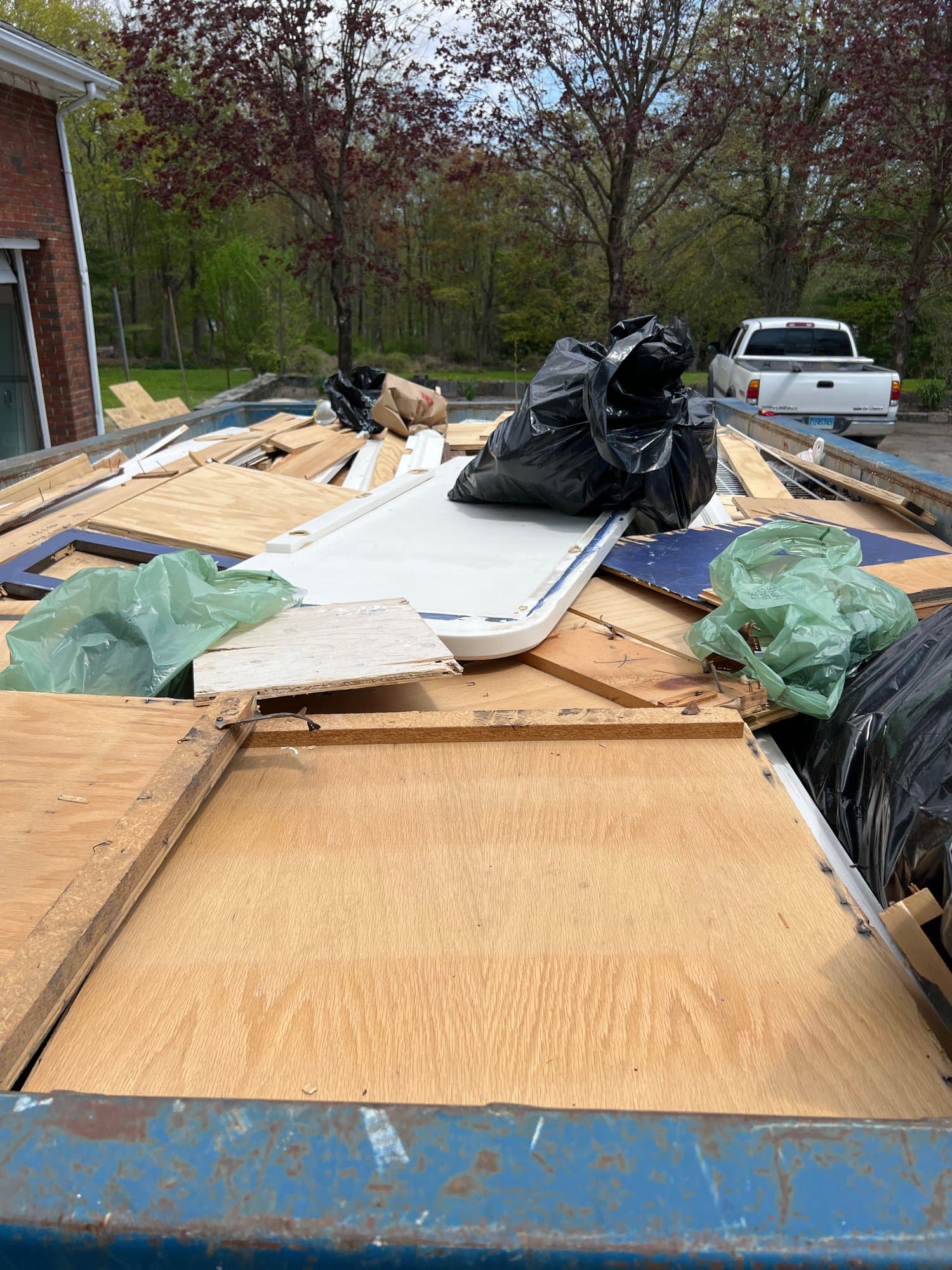
Litchfield County jobs are planned around the driveway as much as the deck. Long gravel drives, steep grades, and tight turnarounds are normal here, and our crews are used to them — but a loaded truck is heavy, and in mud season a soft drive can postpone a job better than any forecast. If your drive is gravel, steep, or freshly thawed, tell us when you book; sometimes the right answer is staging the truck lower and carrying farther, and the walkthrough settles which.
The county sits roughly 45–90 minutes from our yards, so we schedule Litchfield deliberately and bundle where we can — a deck plus a fence run or an old outbuilding makes one mobilization earn its drive.
What rides out with the deck — and what stays put
Everything above grade goes: decking, framing, railings, stairs, lattice skirting, and the hot tub or planter boxes sitting on top if you tell us at the quote. Hardware, joist hangers, and aluminum railing systems get sorted out for metal recycling as we load — no reason to pay disposal tonnage on recyclable metal.
Two materials deserve a straight word. Pressure-treated lumber, which is most Connecticut decks, carries preservative chemicals that rule out burning, chipping, and the neighbor's firewood pile — it's transfer-station material, full stop, and that's where we route it. Composite decking is the other one: dense polymer board that weighs more per foot than dry lumber and is effectively unrecyclable once weathered. Composite jobs tend to land a little higher in their tier purely on tonnage, and we'd rather explain that here than pad a quote quietly.
What stays: concrete. Footings remain in the ground unless extraction was quoted, and slabs or patios under the deck aren't ours to break — concrete is clean-fill work for a different kind of hauler, and pretending otherwise is how demo invoices grow surprises. Want to keep sound lumber for a project? Say so before we start and we'll stack it instead of loading it.
Square footage picks the tier — everything else picks your spot in it
Deck pricing runs on three size tiers, and the grid on this page pulls them live from the same canonical data as our demolition hub — no page-local copies to drift stale. Measure your deck, find your tier, and you're most of the way to your own quote before you call.
What moves you within a tier is the stuff a tape measure doesn't show. Levels, first: every elevated board is slower to drop safely than the same board at grade, so multi-level builds land higher than a single platform of identical footage. Footings, second: cut flush at grade is the fast version; dug out and extracted is real per-hole labor, and Connecticut frost depth means those piers sit deeper than most owners guess. We quote both ways so the choice is a number, not a coin flip. Built-ins, third — benches, planters, pergola posts, and stair runs all add cutting time. And carry distance, always: a deck the truck can park beside is one job, a deck downhill behind the house is another.
The walkthrough is free, the price gets fixed in writing before a single board comes up, and disposal is inside the number. No surprise scale tickets, no demo-day math.
Behind all of it sits the whole state: we take decks down anywhere in Connecticut, each quoted per job — size, height, material, access, and distance all weigh in, never a price card. Photos or a Street View link through the demolition quote form bring back a real number, not a range, and the number we quote is the number you pay.
Demolition pricing — published starting ranges
Every demo job is different — final quote confirmed on site after walkthrough. These are honest starting ranges so you can self-qualify before calling. Disposal of all materials is included in the total.
- Decks (under 200 sq ft)$995+
Small wood deck, single-level, attached or freestanding.
How this job goes →Get a quote for your project → - Decks (200-400 sq ft)$1,395+
Mid-size deck, single-level. Multi-level adds time + cost.
How this job goes →Get a quote for your project → - Decks (400+ sq ft)$2,395+
Large decks. Multi-level, deep footings, or built-ins quoted on site.
How this job goes →Get a quote for your project →
How the pricing works: These are starting prices, and most jobs land here. Every one includes teardown, loading, hauling, and full disposal — no separate dump fee, no labor line added later. What moves the number up: size, how far the structure sits from where the truck can park, whether the crew has to carry debris through a gate or around a house, material, footings or a slab, and distance from our depots for jobs outside Fairfield and New Haven County. Concrete stays unless it's quoted. Send photos and we'll give you a real number — the price we quote is the price you pay, confirmed on site before anything comes down. We don't pull demo permits — that's the homeowner's responsibility when required.
Standalone outbuildings only — no interior demo, no full-house teardowns, no asbestos.
See demolition scopeBoards up, framing down, footprint raked
Deck demolition has a correct order, and we don't improvise it. Decking comes up first — that's the fast, satisfying part. Then the structure underneath comes apart in sequence: railings and stairs off, joists and beams down, posts last, so nothing is ever standing without support while a crew works around it.
Attached decks get the ledger treatment: unbolted from the band joist and removed clean, leaving the house sealed and untouched except for a row of lag holes you can caulk in ten minutes. That's our scope line, held the same on every job — if removing a deck would open the house itself, it belongs to a general contractor and we'll say so at the walkthrough, not on demo day.
Footings go the way you chose at the quote: posts sawed at grade with the concrete staying buried, or each pier dug and pulled where the ground has a future. Mixed answers are fine — pull the six where the garden's going, cut the rest.
Everything loads as it drops, so the yard never sits buried under a debris pile. Last pass is a nail sweep of the work area and a rake of the footprint. Most decks are a one-day job; the big multi-level builds run longer, and we'll tell you which yours is before we book it.
Deck Removal in Litchfield County — questions we actually get
Can I keep some of the lumber?
Sure — tell us before we start and we'll stack what you want to keep instead of loading it. Plenty of customers keep sound joists for projects and send the weathered boards out.
How long does a deck tear-down take?
A standard 12x16 is typically a day: boards up first, then joists and beams, then posts. Multi-level decks or ones with built-in benches, planters, and stairs run longer.
Do the footings come out?
Posts get cut at grade. Concrete footings stay in the ground — concrete isn't something our cans haul, and digging footings is excavation work. Most rebuilds pour new footings anyway.
Can you remove a deck that's attached to the house?
Yes — ledger-unbolt attached decks are in scope. What we won't do is anything whose removal opens the house envelope; if taking the deck off exposes framing or sheathing that needs a contractor's repair, we refer that portion out and say so up front.
Composite decking versus wood — does it matter?
For the tear-down, barely. For the weight, yes — composite runs heavier per board than dry lumber, and weight is what drives dumpster math. We factor the material into the quote so there's no surprise on the scale ticket.
We're second-home owners and only up on weekends — can this happen without us there?
Yes, and it's common here. The walkthrough can land on a weekend you're at the house, or run from photos and a video call with the fixed price confirmed in writing before anything is booked. Demo day itself doesn't need you present — we need access, a dead outlet if the deck has power run to it, and a phone number that answers. Plenty of Litchfield decks have come down on a Tuesday and been a clean footprint by the owner's Friday arrival.
Can a full-size truck make it up our gravel drive?
Usually — and when it can't, the job still happens. We assess the drive at the walkthrough: grade, surface, turnaround room, and how recently the frost came out of it. Where the truck shouldn't climb, it stages at the bottom and the crew carries, which adds labor we price openly rather than a rut in your driveway we'd both regret.
Litchfield County towns we serve
WatertownThomastonPlymouthBethlehemHarwintonLitchfieldMorrisNew HartfordTorringtonWinchester / WinstedCornwallKentSalisburySharonWarrenNew MilfordRoxburyWoodburyBarkhamstedBridgewaterCanaan (Falls Village)ColebrookGoshenNorfolkNorth CanaanWashington
Drive times from our yard run ~45–90 min across the county.
More in Litchfield County
- Hot Tub Removal in Litchfield County
- Shed Removal in Litchfield County
- Above-Ground Pool Removal in Litchfield County
- Fence Removal in Litchfield County
- Garage Demolition in Litchfield County
- House Demolition in Litchfield County
- In-Ground Pool Removal in Litchfield County
- Dumpster rental in Litchfield County
- Deck Removal across Connecticut
- All demolition & removal services
Ready to book your delivery?
Same-day delivery when you call before 11 AM. Trucks dispatch Mon–Sat 8 AM – 4 PM (best-effort scheduling for earlier or later requests). Phones answered 8 AM – 10 PM, 7 days; live team Mon–Fri 8 AM – 4 PM, AI phone assistant other times.