What Mobile Home Demolition Costs in Connecticut
A mobile home teardown isn't a big shed job — there's a steel chassis under it, a title behind it, and sometimes a park with its own rules. Here's what moves the number, and the debris line you can price today.
20,000+
jobs completed
4.99 ★
463 reviews
Family-owned
since 2014 (12 years)
Licensed & insured
in Connecticut & New York
About Grizzly Junk Pros
Grizzly Junk Pros is a family-owned junk removal and dumpster rental company in Connecticut. Justin Hubbard started it in Stamford in 2014 with one box truck. Today we run two depots, in Stamford and West Haven, and have completed 20,000+ jobs. Licensed and insured. Call (203) 219-8855.
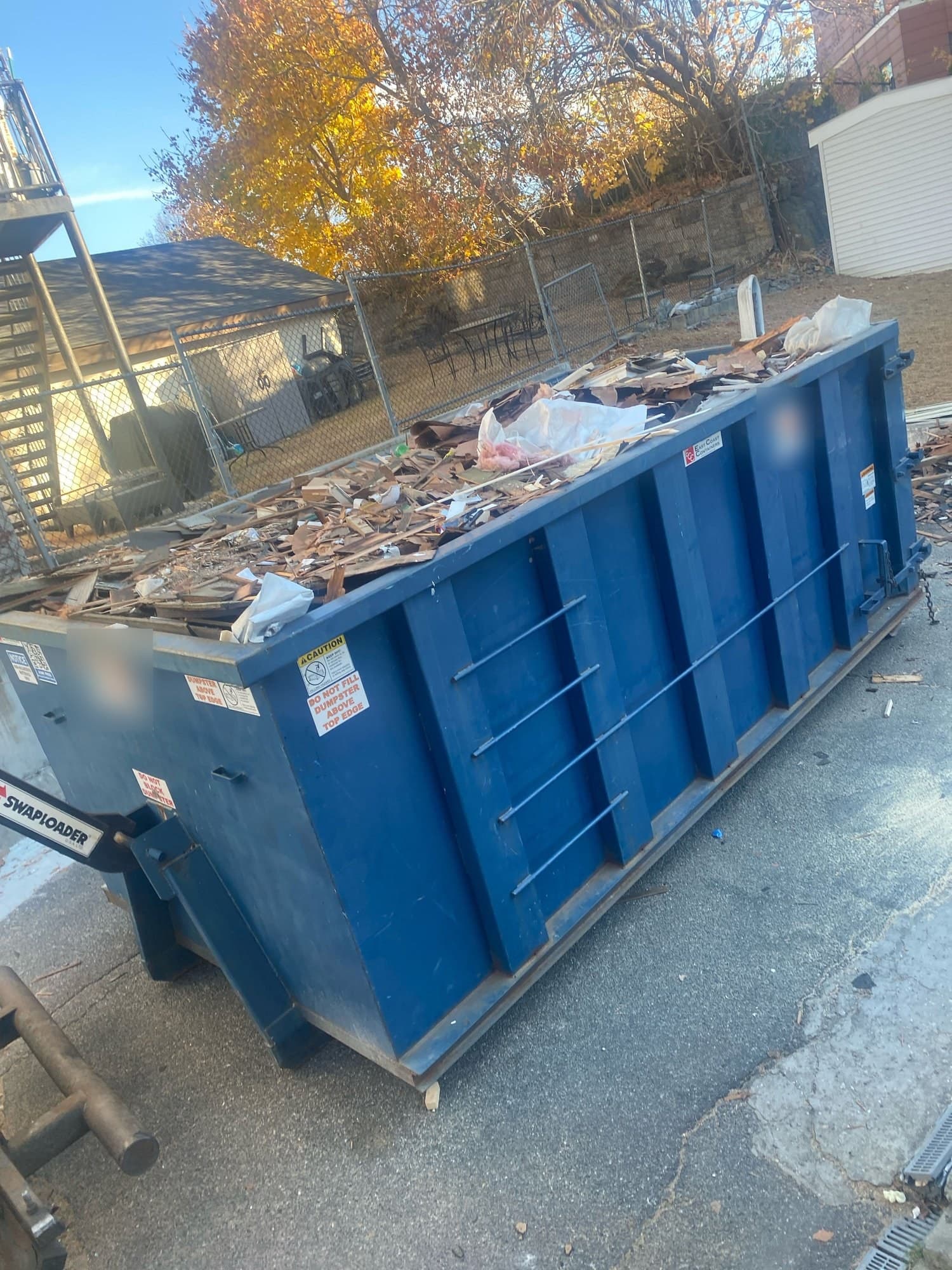
There's a point where a manufactured home stops being a home and becomes a problem sitting on a steel frame. Maybe it's the unit at the back of a family property that nobody's lived in since the nineties. Maybe it's a park lot you're responsible for clearing. Either way, the search that follows is the same: what does it cost to demolish a mobile home in Connecticut?
The honest answer starts with a different question — and then gets into why the printed ranges online won't help you, what actually moves the number, and the one line of the budget that has a public price list.
Who does what — the part to read first
Grizzly is a debris company. Twelve years, sixteen thousand-plus jobs, a fleet of identical roll-off cans out of two Connecticut yards — that's the business. Mobile home demolition is not work we perform, and this cost guide isn't going to pretend otherwise.
The arrangement instead: teardown-in-place is coordinated through our licensed demolition partner, who scopes the unit, writes the quote, holds the license and insurance for the demolition, and contracts that work with you directly. Grizzly handles what leaves the lot — every mixed load goes out in our own dumpsters, on our own trucks, at posted rates. One call starts both halves, the partner's teardown and our debris hauling, and the mobile home demolition page explains the handoff in full.
Read everything below through that split. On the demolition contract, we can tell you what moves the number — we've hauled the debris off enough of these to know the drivers cold. On the debris itself, we can show you the actual rate card.
The cheaper question: can it move?
Before anyone prices a teardown, price the alternative. A mobile home in genuinely transportable condition — frame sound, roofline straight, axles intact or restorable — can sometimes be sold, donated, or relocated for less than the cost of demolishing it. Sometimes for negative cost, if a buyer wants the unit. A mobile home transporter can give you an honest assessment in one visit, and it's worth getting before you commit to demolition money.
We'd rather tell you that up front than have you find out after signing a teardown contract. The units that reach a demolition quote usually can't make the trip — decades of settling, additions built over the tongue, soft floors, a roof reroofed over twice. When a transporter looks at yours and shakes their head, teardown-in-place is the realistic path, and the rest of this post is for you.
What actually moves the quote
| Cost driver | What it means on the ground | Impact on the quote |
|---|---|---|
| Title status | A manufactured home is titled property, and the title has to be settled before the unit is demolished | A paperwork driver, but an absolute gate — nothing schedules until it's resolved |
| Park requirements | Park-sited units carry the park's own removal rules — lot condition, timelines, notice — on top of the town's permit | Adds scope and calendar; skipping this step is how projects stall mid-teardown |
| Single-wide vs. double-wide | Twice the footprint is roughly twice the structure: more machine time, more debris tonnage, two chassis sections instead of one | The main volume driver — it scales the labor and the disposal together |
| Chassis and steel salvage | Under the walls is a steel frame — rails, outriggers, axles — that routes to scrap | The one driver that lowers the number; the scrap stream offsets part of disposal |
| Asbestos survey on older units | Older manufactured housing can carry regulated materials; survey first, licensed abatement before demo if it finds any | The biggest upward swing factor, same as site-built homes |
| Access and machine room | Can an excavator work beside the unit, or is it a tight park lot with neighbors close and utilities overhead? | Tight access slows the work and can change the method |
| Utility disconnects | Electric, water, sewer or septic, and propane or gas each need formal disconnection before teardown | Mostly a timeline driver, but a hard prerequisite |
Notice the pattern: the two biggest unknowns — what the title paperwork looks like and what's inside the walls of an older unit — can't be judged from the curb. That's why this work quotes per project after a site visit, and why any figure printed on a national cost-guide page is describing somebody else's unit.
The sequence before the machine arrives
A mobile home teardown runs through a defined sequence, and knowing it keeps the calendar honest:
- Settle the title. The unit is titled property; the title question gets resolved first. The partner walks owners through what needs doing.
- Confirm park requirements, if the unit sits in one — removal rules, lot-condition expectations, notice periods. Confirmed up front, not discovered mid-project.
- Pull the town's demolition permit. Same as any structure coming down — the process runs through your building department, and one call answers what your town requires.
- Disconnect the utilities and get the confirmations in writing.
- Asbestos survey on older units — and if it finds regulated material, licensed abatement happens before demolition. That's the sequence stated as process, because it is one.
Then the teardown itself, which is the fast part: most of a single-wide comes apart in a day or two. The chassis gets cut and the steel goes to scrap; everything else becomes the debris stream. The paperwork layer, not the machine work, is usually the long part of the calendar.
The debris line — the part with published rates
Everything above prices per project through the partner. The debris doesn't. It moves at posted rates, and the rates are ours.
A demolished mobile home is mostly light material with heavy pockets — paneling, roofing, flooring, insulation, with the dense stuff concentrated in the flooring layers and any additions. The usual booking on a teardown is the 30/40-yard package at $899, which is delivered as two identical 20-yard cans — not one oversized can, because no such can exists on our fleet. The two-can setup fits how this debris arrives: in a burst, over a day or two, either side by side for continuous loading or one swapped for the next as the pile grows.
Smaller scopes book smaller allowances — $447, $547, and $647 cover the 10-, 15-, and 20-yard tiers. Every rental includes 7 days, and weight past the included allowance bills at the posted $0.10 per pound. That overage math is worth respecting on demolition debris: a can hits its weight allowance before it looks full when the flooring layers are wet or the additions were built heavy. The full rate card and weight allowances live on the dumpsters page.
Here's why this matters for reading the partner's quote: the debris line inside it is checkable against a public price list. In demolition, that's rare — and it's the part of the arrangement we can vouch for personally, because it's the part we run.
Getting to a real number
Start with the demolition quote form or a phone call — unit type, single or double-wide, location, and whether it sits in a park. We route the teardown to the licensed partner, the partner scopes the unit and writes the quote, and you contract the demolition directly with the outfit doing the work. Debris runs on our fleet throughout, at the rates above. The mobile home demolition page covers the arrangement in detail, and the demolition overview shows where a manufactured-home teardown sits alongside the structure removal work Grizzly performs itself.
And if the transporter says your unit can still make the trip — take the win. The best demolition quote is the one you never needed.
Ready to talk through your project?
Call (203) 219-8855, 8 AM – 10 PM, 7 days; live team Mon–Fri 8 AM – 4 PM, AI phone assistant other times. Or use the instant-quote tools below.
Looking for service in your area?
We dispatch from two depots — Stamford and West Haven — across 5 CT counties + lower Westchester NY. Each county page rolls up the towns we cover with depot dispatch realities and same-day-vs-next-day framing.
Related posts
- Pricing8 min read
What House Demolition Really Costs in Connecticut
Every printed house-demo price range online is too wide to plan with. Here's what actually moves the number, what has to happen before the first machine arrives, and the debris line — the one part with published rates.
By Justin Hubbard - Pricing8 min read
In-Ground Pool Removal Cost in Connecticut
Partial fill or full removal is the first decision, and it changes the price, the paperwork, and what you can build there later. The honest version of both options, plus the one budget line with published rates.
By Justin Hubbard - Pricing7 min read
Above-Ground Pool Removal Cost in Connecticut
The two-tier reality of above-ground pool removal cost in CT — with or without decking — plus draining logistics, the right teardown order, and why the sand stays.
By Justin Hubbard
Answered 8 AM – 10 PM, 7 days; live team Mon–Fri 8 AM – 4 PM, AI phone assistant other times.