In-Ground Pool Removal Cost in Connecticut
Partial fill or full removal is the first decision, and it changes the price, the paperwork, and what you can build there later. The honest version of both options, plus the one budget line with published rates.
20,000+
jobs completed
4.99 ★
463 reviews
Family-owned
since 2014 (12 years)
Licensed & insured
in Connecticut & New York
About Grizzly Junk Pros
Grizzly Junk Pros is a family-owned junk removal and dumpster rental company in Connecticut. Justin Hubbard started it in Stamford in 2014 with one box truck. Today we run two depots, in Stamford and West Haven, and have completed 20,000+ jobs. Licensed and insured. Call (203) 219-8855.
Connecticut is full of in-ground pools that nobody has swum in for years. They sit there consuming chemicals, insurance riders, and one weekend a month, waiting for a decision. When the decision finally comes, the first search is always the same — what does it cost to remove an in-ground pool? — and the first thing you'll notice is that the internet's answer swings wildly depending on which page you land on.
There's a reason for that swing, and it isn't sloppy writing. It's that "pool removal" is two different projects wearing one name, performed on pools that vary enormously in construction, size, and access. This post separates the two projects honestly, lays out what actually drives the number, and then covers the single line of the budget that has published pricing: the debris.
Who does what on this job
Straight answer before anything else: Grizzly does not excavate pools. We're a debris and hauling company — that's the fleet, the licenses, and the twelve years of experience we actually have. In-ground pool removal is coordinated through our licensed demolition partner, who walks the property, writes the quote, and contracts the excavation work with you directly. Our side is everything that leaves the site: broken gunite, deck slab, coping, the works — every load goes out in our own dumpsters at our posted rates. One call starts both halves (the partner's excavation and our debris hauling); the in-ground pool removal page explains the handoff.
So read this guide the way it's written: on the excavation contract, we can tell you what moves the number, because we've hauled the debris off enough of these jobs to know. The number itself comes from the partner's walkthrough of your actual pool.
The first decision: partial fill or full removal
Every pool removal conversation starts here, because the choice changes the price, the debris volume, the timeline, and — this is the part too many pages skip — what the ground is good for afterward.
Partial fill (sometimes called partial removal or fill-in-place) breaks up the deck and the top few feet of the pool walls, punches holes through the bottom of the shell so water can drain instead of ponding, drops the broken material into the deep end, and fills the rest with soil, compacted in lifts. The lower shell stays in the ground forever. It's the less expensive option — less machine time, less material hauled away, less fill trucked in — and for a yard that's going back to lawn, it's often the sensible call.
Full removal takes the entire shell out of the ground — walls, floor, footings — and rebuilds the hole with clean fill, compacted properly. More excavation, more debris, more imported fill, more money. What you get for it is ground with no buried structure and no asterisk.
Here's the honest caveat that belongs in every partial-fill conversation, and we'll put it in bold because it's the sentence people wish they'd read earlier: a filled pool is commonly recorded on the property file, and building over a partial fill has rules. Many Connecticut towns treat partially filled pool ground as unbuildable unless the fill was engineered and documented; buyers' inspectors and appraisers know to ask; and a future addition, garage, or even a large shed over that spot can turn into an engineering conversation years after the excavator left. None of that makes partial fill wrong — it makes it a decision to document. Get the fill spec in writing: what went in the hole, in what lifts, compacted how, signed by whom. If there's any real chance the ground needs to carry a structure someday, say so before the quote is written, because it changes which option you should buy.
What moves the quote
| Cost driver | What it means on the ground | Impact on the quote |
|---|---|---|
| Partial fill vs. full removal | The scope decision above — how much shell comes out and how much fill goes in | The single biggest fork in the price |
| Pool construction | Gunite/concrete is the heavy case — thick reinforced shell, dense debris. Vinyl-liner and fiberglass shells come out with far less breaking | Gunite pushes machine time and disposal tonnage up substantially |
| Size and depth | A deep-end diving pool holds a lot more shell and needs a lot more fill than a shallow lap pool | Scales the whole job — excavation, debris, and imported fill together |
| Access | Can an excavator reach the pool, or does a fence, slope, septic field, or tight side yard stand in the way? | Tight access slows everything; genuinely blocked access changes the method |
| Decking and patio scope | Just the pool, or the surrounding concrete apron, patio, and equipment pad too? | Every square foot of slab is more breaking and more tonnage |
| Fill and drainage | Fill has to be trucked in and compacted; wet ground and drainage problems complicate both | Mostly scales with the fill volume; poor drainage adds real work |
| Utility disconnects | Pool electrical made safe at the panel, gas heater lines capped, plumbing dealt with — before machine work | Mostly a sequencing item, but old or undocumented lines add time |
The pattern is the same one that governs every demolition project: most of what sets the price can't be seen from the driveway. Shell construction, access, drainage, what's under the deck — they get read at a site visit, which is why the quote is per project and in writing. The wide printed ranges online aren't lying to you; they're just averaging across pools that have almost nothing in common.
The parts you can pin down in advance
Three lines of a pool-removal budget are knowable before anyone visits your property.
The permit. Pool removal takes a permit in most Connecticut towns — it's excavation, demolition, and fill work on a recorded structure. The fee is set by your town, so call the building department and ask; the answer is exact and the conversation is short. While you have them, ask how they handle the property record for a filled pool — better to hear the answer now than at closing.
The survey work, if any. Full-removal jobs that involve engineered fill sometimes want compaction testing or an engineer's sign-off. If your plan includes ever building over the spot, that documentation is the whole game — the professionals who provide it quote it directly.
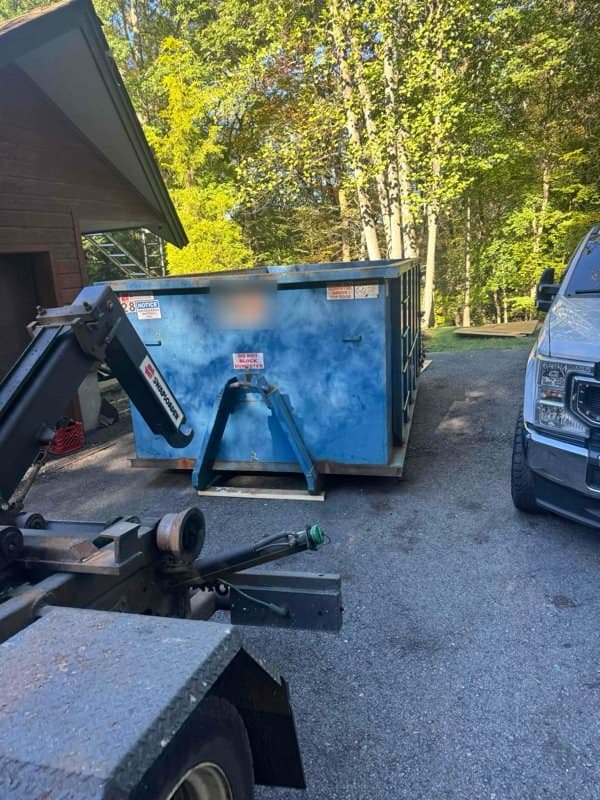
The debris. This is where the published numbers live, because this is our half of the job. Pool debris moves in Grizzly roll-off cans at posted rates: $447 for the 10-yard weight allowance, $547 for the 15, $647 for the 20, and $899 for the 30/40 tier — delivered as two 20-yard cans, never one oversized can, either staged together or swapped as each fills, which suits the rhythm of an excavation job where debris comes off in surges. Every rental includes 7 days, and overage past the included weight bills at $0.10 per pound.
That overage line deserves a hard look on this project in particular: broken gunite is one of the densest debris streams in residential work. A can of concrete rubble reaches its weight allowance while looking half empty. That's not a trap, it's physics — but it means an honest pool-removal debris budget is built on tonnage, not on how full a can looks, and it's why the coordinated jobs plan haul cycles instead of one heroic overloaded container. The full rate card and per-size weight allowances are on the dumpsters page.
Getting to a real number
Send the demolition quote form or call with the basics: pool type if you know it (gunite, vinyl, fiberglass), rough dimensions, whether you're leaning partial or full, and what you want the ground to do afterward — lawn, patio, or someday-a-structure, because that last one changes the right answer. We route it to the licensed partner, the partner walks the property and writes the per-project quote, you contract the excavation directly, and the debris runs on our fleet from the first bucket of broken deck to the last. The in-ground pool removal page covers the full arrangement, and the demolition overview shows which removal work we perform ourselves and which, like pool excavation, runs through our licensed partner.
The pool stopped being a pool a while ago. What it becomes next — and what that costs — starts with a walkthrough, and now you know every question worth asking when the quote lands.
Ready to talk through your project?
Call (203) 219-8855, 8 AM – 10 PM, 7 days; live team Mon–Fri 8 AM – 4 PM, AI phone assistant other times. Or use the instant-quote tools below.
Looking for service in your area?
We dispatch from two depots — Stamford and West Haven — across 5 CT counties + lower Westchester NY. Each county page rolls up the towns we cover with depot dispatch realities and same-day-vs-next-day framing.
Related posts
- Pricing8 min read
What House Demolition Really Costs in Connecticut
Every printed house-demo price range online is too wide to plan with. Here's what actually moves the number, what has to happen before the first machine arrives, and the debris line — the one part with published rates.
By Justin Hubbard - Pricing7 min read
What Mobile Home Demolition Costs in Connecticut
A mobile home teardown isn't a big shed job — there's a steel chassis under it, a title behind it, and sometimes a park with its own rules. Here's what moves the number, and the debris line you can price today.
By Justin Hubbard - Pricing7 min read
Above-Ground Pool Removal Cost in Connecticut
The two-tier reality of above-ground pool removal cost in CT — with or without decking — plus draining logistics, the right teardown order, and why the sand stays.
By Justin Hubbard
Answered 8 AM – 10 PM, 7 days; live team Mon–Fri 8 AM – 4 PM, AI phone assistant other times.