What House Demolition Really Costs in Connecticut
Every printed house-demo price range online is too wide to plan with. Here's what actually moves the number, what has to happen before the first machine arrives, and the debris line — the one part with published rates.
20,000+
jobs completed
4.99 ★
463 reviews
Family-owned
since 2014 (12 years)
Licensed & insured
in Connecticut & New York
About Grizzly Junk Pros
Grizzly Junk Pros is a family-owned junk removal and dumpster rental company in Connecticut. Justin Hubbard started it in Stamford in 2014 with one box truck. Today we run two depots, in Stamford and West Haven, and have completed 20,000+ jobs. Licensed and insured. Call (203) 219-8855.
Somewhere on your street, or maybe on your own lot, there's a house that has stopped being worth saving. Fire, decades of deferred everything, a foundation problem that ate three contractors' optimism — the reasons vary, but the search that follows is always the same: what does it cost to demolish a house in Connecticut?
Here's the honest answer up front, because it's the part most pages bury: the printed ranges you'll find online swing so wide they're useless for planning. Not because the sites publishing them are lazy — because house demolition genuinely doesn't price from a chart. It prices from a site visit. This post explains why, walks through what actually moves the number, and then covers the one line of the budget that does have a public price list: the debris.
Who does what — read this part first
We're a debris company. Twelve years of hauling, sixteen thousand-plus jobs, a fleet of roll-off cans — that's what Grizzly is. Full house demolition is not work we perform, and we're not going to write a cost guide that pretends otherwise.
What we do instead: house demolition is coordinated through our licensed demolition partner. The partner walks the property, writes the quote, holds the license and the insurance for structural teardown, and contracts that work with you directly. Grizzly handles what comes off the site — every load of debris goes out in our own dumpsters, on our own trucks, at our posted rates. One call to us starts both halves of the job, the partner's demolition and our debris hauling, and the house demolition page lays out how the handoff works.
That split matters for how you should read everything below. On the demolition contract itself, we can tell you what moves the number — we've staged debris on enough teardowns to know the drivers cold — but the number itself comes from the partner's walkthrough, in writing, for your specific house. On the debris, we can do better than drivers: we can show you the actual rate card.
Why the online ranges fail you
Search "house demolition cost" and you'll get ranges wide enough to park a house in. The low end assumes a small, clean, wood-framed structure with truck access on all four sides and nothing surprising in the walls. The high end assumes masonry, asbestos abatement, a tight urban lot, and full foundation removal. Your house sits somewhere between those two imaginary houses, and no chart can tell you where.
A range that wide isn't information — it's the shape of information. The useful version is understanding which drivers apply to your property, so that when the per-project quote arrives, you can read it line by line and know why it says what it says.
What actually moves a house demolition quote
| Cost driver | What it means on the ground | Impact on the quote |
|---|---|---|
| Square footage | More structure is more machine time and more tonnage — but it scales less steeply than people assume | Sets the baseline, doesn't dominate it |
| Construction type | Wood frame comes down fast; masonry, brick veneer, and plaster-heavy interiors are slower work and far denser debris | Masonry pushes both labor and disposal up substantially |
| Asbestos findings | Siding, pipe wrap, floor tile, roofing on older stock — regulated material means licensed abatement before demo | The single biggest swing factor; abatement is its own scoped project |
| Site access | Can an excavator work beside the house, or is it a tight lot with neighbors close on both sides? | Tight access slows everything and can change the method entirely |
| Foundation and basement scope | Structure-only to grade, versus breaking out the foundation, versus a full basement dig-out and backfill | Each step down adds machine work, material handling, and fill |
| Utility disconnects | Electric, gas, water, sewer — each must be formally disconnected and confirmed before teardown | Mostly a timeline driver, but complicated services add real cost |
Notice what's not on the list: anything you can measure from the curb. That's the structural reason phone quotes don't exist for this work. Three of the six drivers live inside the walls or under the ground.
The pre-teardown sequence
A house doesn't go from occupied to gone in one step, and the steps in between are where first-timers lose weeks. The sequence runs like this, and most of it can start in parallel the week you decide to proceed:
- Demolition permit. A house teardown is the most permit-certain project in residential construction — every Connecticut building department wants paperwork before a dwelling comes off its records. Requirements and fees are set town by town, so the first call is to your building department: ask what a residential demolition requires. Expect the town to want proof of the other items on this list before signing off.
- Utility disconnect confirmations. Electric, gas, water, and sewer each get formally disconnected at the source by the utility or a licensed trade — and confirmed in writing, because the building department and the demolition contractor will both ask for the confirmations, not your word. This is the step that most often sets the real start date, so make the calls early.
- Asbestos survey — and abatement first if it finds anything. On older Connecticut housing stock, a pre-demolition asbestos survey is standard practice, and it's the step you should be most suspicious of any contractor for skipping. If the survey identifies regulated material, licensed abatement crews remove it before demolition. Not during, not "we'll be careful around it" — before. It's the law's sequence and it's the safe sequence, and it's also the honest explanation for why two similar houses can carry very different project totals.
Once those three clear, the teardown itself is the fast part. The machine work on a typical house is measured in days. The paperwork ahead of it is measured in weeks — plan the calendar around the prep, not the demolition.
The one line you can price today: the debris
Everything above gets quoted per project by the demolition contractor. The debris doesn't. Debris moves at published rates, and those rates are ours.
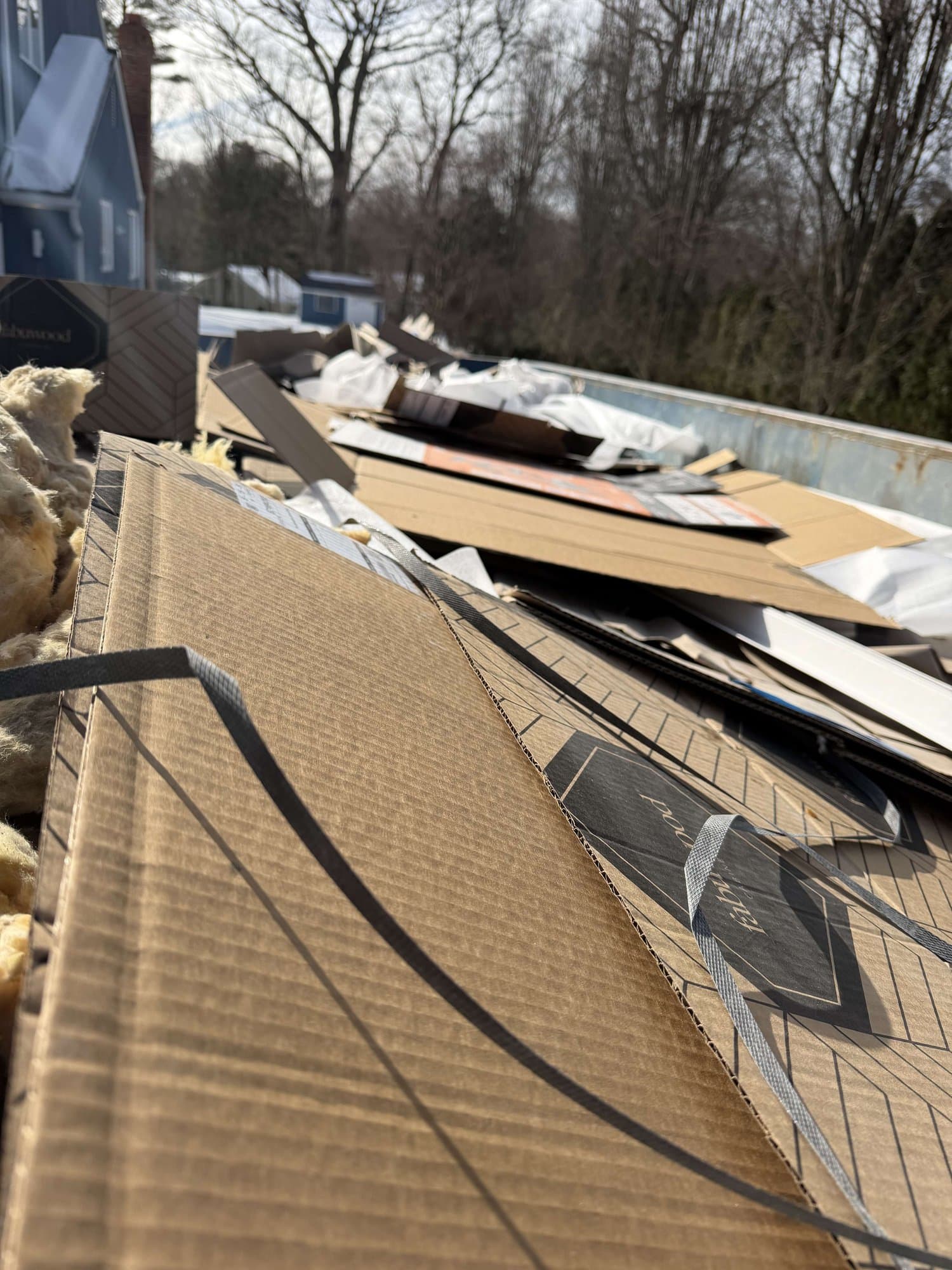
A demolished house is tonnage — framing, roofing, plaster, flooring, the whole envelope reduced to loads. On a coordinated teardown, that material goes out in Grizzly roll-off cans at the same posted terms every customer gets, and you can read them before anyone visits your property:
- $447 for the 10-yard weight allowance, $547 for the 15, $647 for the 20, and $899 for the 30/40 tier — which is delivered as two 20-yard cans, not one oversized can, either side by side or one swapped for the next as it fills. That two-can setup is built for exactly this kind of job: continuous loading without waiting on a haul cycle.
- Every rental includes 7 days, and overage past the included weight bills at $0.10 per pound — which matters on demolition debris more than almost any other stream, because plaster, shingles, and masonry are dense. A can of house debris hits its weight allowance long before it looks full, and honest budgeting means expecting overage or extra hauls on the heavy fractions rather than being surprised by them.
- The full rate card, weight allowances by size, and the overage math live on the dumpsters page.
Why this matters for your planning: when the per-project quote arrives, the debris line inside it is checkable against a public price list. That's rare in demolition, and it's the part of the arrangement we can personally vouch for, because it's the part we run.
Getting to a real number
Start with the demolition quote form or a phone call — rough square footage, construction type if you know it, what you want to happen with the foundation, and a few photos help. We route house teardowns to the licensed partner, the partner walks the property and writes the quote, and you contract the demolition directly with the outfit doing the work. Debris runs on our fleet throughout. The house demolition page covers the full arrangement, and the broader demolition overview shows which structure removal work we perform ourselves and which, like a house teardown, runs through our licensed partner.
The ranges online will keep swinging. The number that matters comes from a walkthrough of your actual house — and now you know how to read it when it arrives.
Ready to talk through your project?
Call (203) 219-8855, 8 AM – 10 PM, 7 days; live team Mon–Fri 8 AM – 4 PM, AI phone assistant other times. Or use the instant-quote tools below.
Looking for service in your area?
We dispatch from two depots — Stamford and West Haven — across 5 CT counties + lower Westchester NY. Each county page rolls up the towns we cover with depot dispatch realities and same-day-vs-next-day framing.
Related posts
- Pricing8 min read
In-Ground Pool Removal Cost in Connecticut
Partial fill or full removal is the first decision, and it changes the price, the paperwork, and what you can build there later. The honest version of both options, plus the one budget line with published rates.
By Justin Hubbard - Pricing7 min read
What Mobile Home Demolition Costs in Connecticut
A mobile home teardown isn't a big shed job — there's a steel chassis under it, a title behind it, and sometimes a park with its own rules. Here's what moves the number, and the debris line you can price today.
By Justin Hubbard - Pricing7 min read
Above-Ground Pool Removal Cost in Connecticut
The two-tier reality of above-ground pool removal cost in CT — with or without decking — plus draining logistics, the right teardown order, and why the sand stays.
By Justin Hubbard
Answered 8 AM – 10 PM, 7 days; live team Mon–Fri 8 AM – 4 PM, AI phone assistant other times.