Family-owned since 2014 · 4.99 ★ × 463 reviews · 20,000+ jobs
Barn & Outbuilding Demolition in Connecticut
Barn and outbuilding teardowns coordinated through our licensed demolition partner — transite screened first, and every load of debris goes out in our own dumpsters.
20,000+
jobs completed
4.99 ★
463 reviews
Family-owned
since 2014 (12 years)
Licensed & insured
in Connecticut & New York
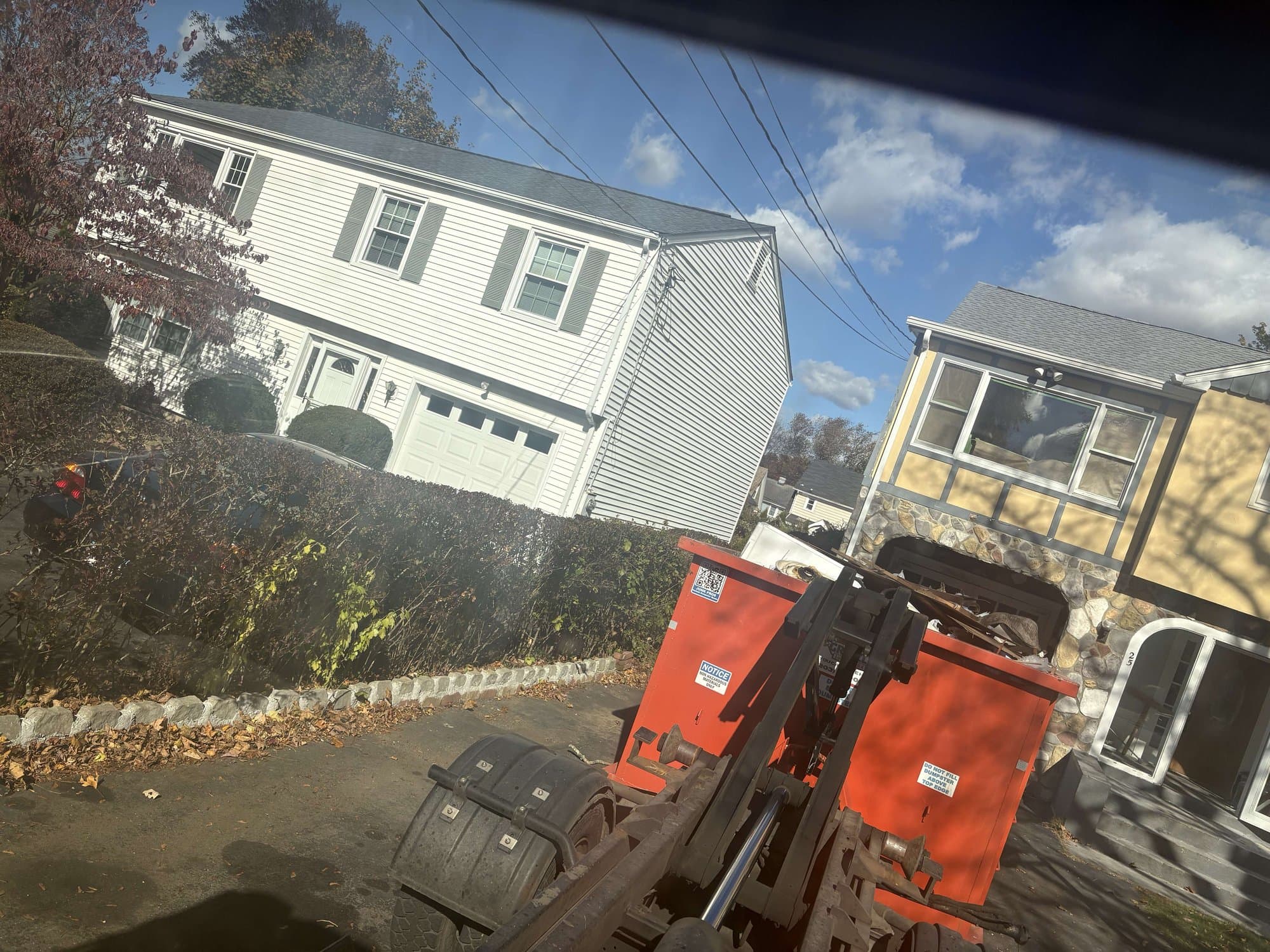
No two Connecticut barns were built the same way, and by the time somebody calls about taking one down, none of them are standing quite the way their framing suggests. Sills gone at the stone line, a loft holding decades of weight it was never asked to hold, a roof that has been shedding its own structure for years — a barn is a demolition project, not a big shed.
So the split gets stated up front. Grizzly does not perform barn demolition. The teardown is coordinated through our licensed demolition partner, a licensed and insured demolition contractor who walks the structure, reads how it wants to come down, quotes the work, and contracts it with you directly. What Grizzly runs end to end is the debris — and a barn produces a great deal of it. Every load goes out in our own dumpsters at the posted rates published across this site.
One thing before you compare quotes from anyone: if your barn predates 1980, the siding question comes first. That section is next.
The transite question comes first
A lot of Connecticut outbuildings built between the 1940s and the 1970s were clad in transite — asbestos-cement panels that read as brittle gray board siding, sometimes with a faint wave to them. Left alone, transite sits there harmlessly. Broken by demolition, it becomes exactly the airborne hazard the licensing rules exist for.
So the screening is not a formality, and it happens before anything is scheduled. Pre-1980 siding and roofing get looked at as part of the partner's scoping walk, and where the material is suspect, the sequence is fixed: testing and licensed abatement first, under the containment and manifests that trade requires, then demolition of the cleared structure. Two contractors, in that order, no exceptions.
Grizzly's side of that rule is just as firm — abatement waste never rides in our cans. The loads we haul are strictly the post-abatement debris stream. Anyone who shrugs and says they'll "just be careful" with transite is telling you everything you need to know about the rest of their operation.
Most post-1980 outbuildings — and plenty of older ones — screen clean, and the job proceeds like any other teardown.
How the referral works
- You bring us the project. Call (203) 219-8855 or send the demolition quote form — rough footprint, the decade it went up if you know it, what's stored inside, and how a truck reaches the site. Photos of the siding are the most useful thing you can send, because they start the transite question early.
- The partner scopes and contracts the demolition. A licensed demolition contractor walks the barn — framing condition, lean, loft load, foundation, salvage requests — and puts the demolition price and contract in front of you under their own name. Permitting rides in that sequence; barns are on the town's records more often than not, and rural building departments want to know when one comes down.
- Grizzly runs the debris and the cleanout. Contents cleared first as junk removal, then cans placed and swapped on the demolition schedule, hauled at posted rates. The 20-yard package is the usual workhorse for a barn's debris volume.
Two contracts, plainly separated: the teardown from the contractor who performs it, the debris from the fleet that hauls it.
Flag your keepers before the job starts
Barns are the one structure where salvage is worth a real conversation. Hand-hewn beams, wide-plank board siding, strap hinges, sliding-door hardware, sash windows — the materials in an old Connecticut outbuilding are sometimes worth more than the structure standing around them.
Tell us at intake what you want saved and the teardown gets planned around it: flagged pieces come off first and intact, stacked wherever you point, before the demolition proper starts. Selective disassembly is slower than a straight teardown, so it shows up in the partner's quote as time — and for a barn with good bones, it's usually the line owners are happiest to pay.
What we won't do is appraise it. We're haulers, not salvage brokers. The honest read on most of it is in the next section.
What happens to the lumber
Straight answer: most of it is garbage, and it rides out with the rest of the debris to a licensed transfer station in our own cans. Connecticut barn lumber has usually spent a century collecting everything that disqualifies a board — rot at the sill line, powder-post beetle tracks, a hundred years of nails, and paint old enough to be its own problem. We're haulers, not a reclaimed-lumber dealer, and we won't dress that up.
If your barn has something genuinely worth saving — a hand-hewn beam, a run of wide boards — say so before the job starts and the teardown gets planned so those pieces come off intact and stay with you. Be warned that the honest walkthrough answer is usually that little of it is worth keeping. What's flagged gets saved; what isn't goes on the truck.
The part Grizzly controls end to end
Here's the plain industry fact behind this arrangement: demolition contractors rent their roll-off containers from someone. Grizzly owns a hundred identical cans, staged out of two Connecticut yards and dispatched by the same people who take the first call. Debris volume is the part of a barn project Grizzly controls outright.
Barns produce more of it than their footprint suggests. Old framing is dense, plank floors are heavy, roofing carries whatever went over it in the decades since, and a loft's worth of stored weight is usually still up there when the call comes. Cans get placed before the first demolition day and swapped as they fill, on the demolition schedule rather than ahead of it, at the same posted rates every dumpster customer on this site pays.
No third hauler in the middle. No markup on somebody else's fleet. And no confusion about which contractor owns which number.
Got a barn coming down?
One call sets up both halves — the partner quotes the demolition, Grizzly quotes the dumpsters and the cleanout.
Barn demolition FAQs
Who actually takes the barn down?
Our licensed demolition partner. Barns are old, heavy, and rarely standing the way their framing suggests, so the teardown is scoped, quoted, and contracted by a licensed demolition contractor rather than by us. Grizzly's lane is the part a barn produces most of: debris. Every load goes out in our own dumpsters at the posted rates published across this site.
Is old barn wood worth saving?
Occasionally — a sound chestnut or oak beam has real salvage value, and a run of wide boards sometimes does. Flag what you want kept before the job starts and it gets set aside instead of loaded. The honest answer on most Connecticut barns is that very little of it survives a century of rot, beetles, nails, and old paint.
Do barns need a demolition permit?
Frequently, because they're real structures on the town's records — rural towns especially want to know when a barn on the grand list comes down. Permitting is folded into the partner's contracting sequence, and your building department answers the rest in one short call.
What about hay, manure, and whatever's inside?
Contents are Grizzly's own service — junk removal, quoted by volume and usually cleared before demolition day so the structure gets scoped empty. Genuinely agricultural waste like a manure pile is farm-management territory rather than C&D, and we'll say plainly where that line falls.
The barn is leaning hard — does that change the job?
It changes the order of operations, and it's a large part of why barns are partner work. A racked structure comes down from the safe side first, sometimes pulled over deliberately before anyone works near it, and that judgment belongs to a licensed demolition contractor standing on the property. Our cans arrive on the schedule that plan sets.
Is there asbestos in an old barn?
There can be. Transite — asbestos-cement board siding and roofing — was common on outbuildings from the 1940s through the 1970s, and it's harmless standing still and hazardous the moment demolition breaks it. Pre-1980 barns get screened before anything is scheduled; where suspect material turns up, licensed abatement happens first and none of it ever rides in our cans.
Can Grizzly clear the barn out before the teardown?
Yes, and it's usually the first thing scheduled. Clearing a barn is junk removal — Grizzly's own service, our own teams, quoted by volume. Decades of tools, tack, furniture, and whatever the last three owners left behind come out before the partner scopes the structure, which makes their walk-through more accurate and the demolition day shorter. Fuel, oil, and old farm chemicals route through your town's hazardous-waste program instead.
What happens to a stone or rubble foundation?
It stays, unless foundation work is written into the partner's scope. The structure comes down to the top of the stone and the stone stays put — hauling foundation rubble and broken masonry is clean-fill work with its own stream, and it never rides in our cans. Plenty of owners keep the old foundation ring as a garden border or a landscape feature.
Related pages
- Demolition overview — the full two-track picture: what Grizzly takes down itself, and what runs through the partner
- Barn cleanouts — clearing the contents and keeping the barn standing
- Shed removal — the smaller end of the outbuilding family, and work Grizzly self-performs
- Chicken coop removal — coops, runs, and small backyard structures
- Detached garage demolition — similar scale, same coordinated track
- House demolition — when the barn isn't the only structure on the list
- 20-yard dumpster rental — the debris workhorse for outbuilding teardowns
Request a barn demolition quote
Call (203) 219-8855 — text photos of the siding to the same number and the transite question gets answered before anyone drives out. Phones answered 8 AM – 10 PM, 7 days; live team Mon–Fri 8 AM – 4 PM, AI phone assistant other times.