Grizzly Junk Pros · Family-owned since 2014 · 4.99 ★ × 463 reviews · 20,000+ jobs
Garage Cleanout in Farmington, CT
Priced by truck space. The paint and the gas can get routed, not loaded. Hartford County.
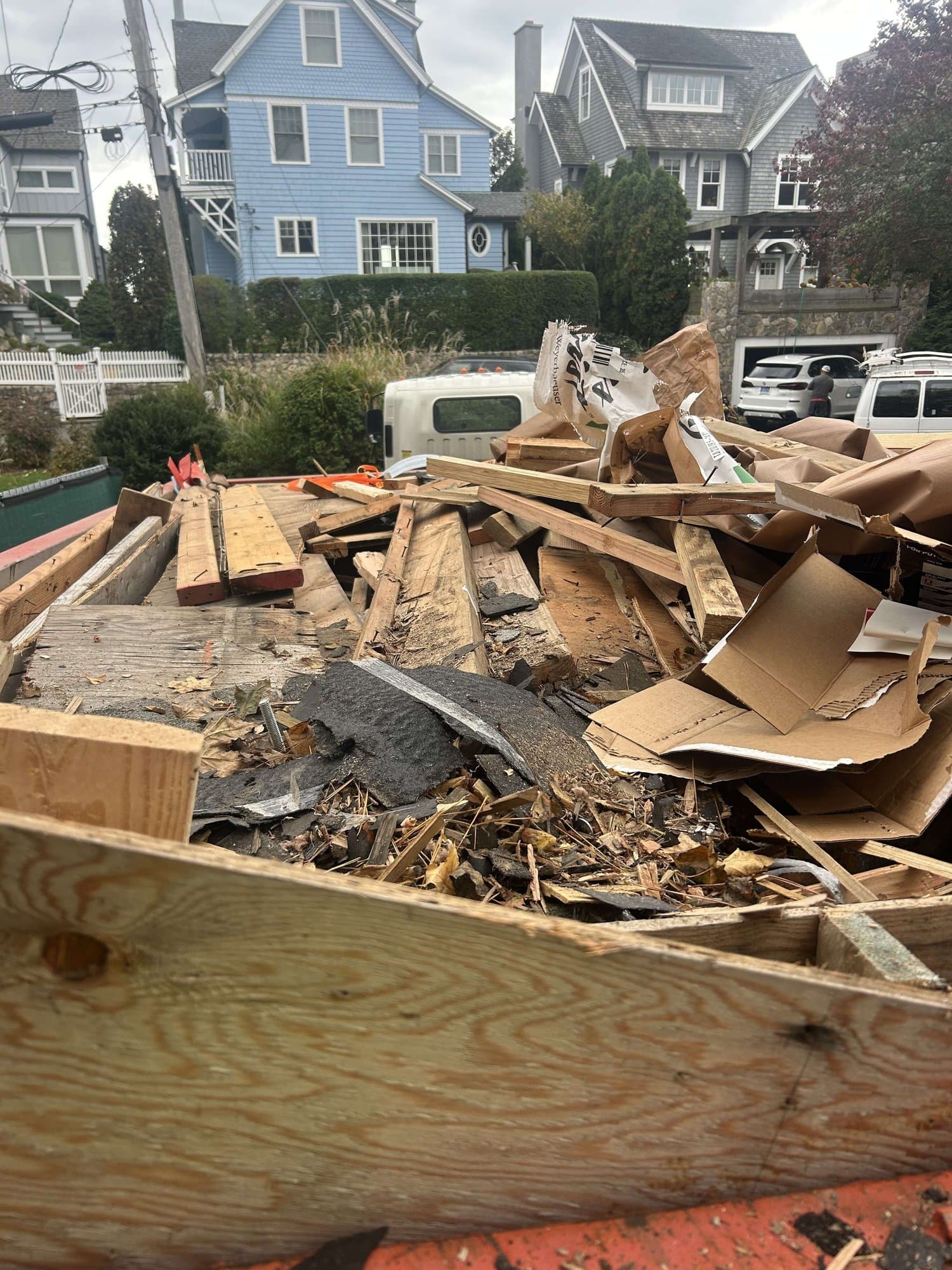
The honest framing for a Farmington garage cleanout is that you may not need us. A single carload of ordinary junk is a trip to your own transfer station and an afternoon. What changes the maths is volume, heavy shelving, anything that needs disassembly, and the pile of paint and fuel containers that a town facility handles differently from household waste. We've put all of that below rather than just the phone number.
20,000+
jobs completed
4.99 ★
463 reviews
Family-owned
since 2014 (12 years)
Licensed & insured
in Connecticut & New York
What Farmington garages tend to hold
Farmington garages are two different jobs. The historic district and older Farmington Avenue stock have small detached garages with narrow openings, sometimes barn-derived, where disassembly is part of the work. Unionville, South Farmington, Mountain Spring and Farmington Woods are newer, with attached two- and three-car garages, room in the driveway and the volume that implies. Farmington also has no municipal transfer station, which changes the self-haul calculation more than in any neighbouring town.
We work across Farmington Village historic, Unionville, Farmington Avenue corridor and Talcott Mountain area, in a town of about 26,500.
Start to finish
Estimate. Garages quote well from photographs — send two or three and we'll give you a tier without a site visit. It's the most predictable space in a house.
Sort. The crew works from the door inward, staging truck-bound material outside and setting aside anything that can't legally travel. That second group is identified item by item rather than lumped together as "hazardous".
Dismantle. Wall units, steel shelving and workbenches usually need breaking down. Included.
Load. Truck space off the standard ladder, agreed on site.
Hand over the list. What's left, what it is, and which local facility takes it. We would rather spend five minutes on that than have you find a fuel can in an empty garage after we've gone.
What we can't take out of a garage
This is the part that makes a garage different from every other cleanout. More prohibited material turns up here than in a basement, an attic or a whole house — and none of it can ride in our truck or in a rented can:
- Paint, stain, solvent, thinner. Connecticut runs PaintCare drop-off sites that take leftover architectural paint free. Fully dried-out latex with the lid off is usually acceptable as ordinary waste — check your town's rule first.
- Gasoline, diesel, kerosene, motor oil, antifreeze. Household hazardous waste collection, or in many towns a waste-oil tank at the transfer station.
- Anything with fuel still in it. Mowers, blowers, trimmers, generators, chainsaws. Drain the tank and we can take the machine.
- Propane cylinders. Grill tanks and camping canisters. Many Connecticut towns now take these free through cylinder-recycling programmes.
- Pool and lawn chemicals, pesticides, fertiliser. Household hazardous waste, always.
- Car batteries and tires. Accepted at most town facilities, frequently free, but never in a general load.
- Asbestos-containing material. Old siding or pipe wrap in a detached garage. Licensed abatement first — we stop and tell you.
We separate this as we work and show you what's left before we leave. Nothing gets quietly loaded, and nothing gets abandoned in a corner without you knowing it's there. The full reference is what can and can't go in a dumpster.
Pricing
The ladder is the same one we use for every job — you're buying truck space, not paying by the item:
- $179 — minimum load, for a handful of things rather than the whole space
- $359 — 1/4 truckload (~5 yd³), the usual figure for a one-car garage
- $559 — 1/2 truckload (~10 yd³), the usual figure for a filled two-car
Garages estimate unusually well from photos. Send a couple and you'll get a tier before anyone drives out — worth doing, because it also tells you whether hiring is worth it at all versus a couple of trips of your own.
Hire, or handle it yourself?
Farmington's own option. Details and the source link are in the disposal section further down this page.
Do it yourself if: it's two or three carloads, nothing is bolted down, and you have the weekend.
Call us if: the shelving is coming with it, the volume is past a few trips, the garage doubles as a workshop, or you'd rather not spend a Saturday queuing at a transfer station.
Either way the hazardous items follow the same route — they don't go in our truck any more than they go in your trunk.
Disposal in Farmington
Verified from Farmington’s own municipal pages — every fact links its source.
Farmington’s posted disposal point: No municipal transfer station — Farmington runs town-cart curbside collection. ‘No bulk items, construction debris, hazardous items, or flammable materials in cart.’ source It does not accept construction and demolition debris source — on our jobs that stream rides out in our own cans to a private C&D facility instead.
For furniture-scale material: Cart-based curbside service — ‘Carts should be placed within 6 feet of curb, 4 feet away from other objects, and with the front of the cart facing the street.’ ‘Additional recycling carts can be purchased for a one-time charge of $100 per cart (95 gallon or 65 gallon)’; ‘Additional trash carts: one-time charge of $120 plus the annual special tax charge (95 gallon or 35 gallon)’. The town publishes separate Bulk Waste Collection and Disposal of Other Materials pages. source (program info)
See the full Connecticut Transfer Station Guide →
Street placement? The dumpster-permit answer, statewide. Loading rules? What can’t go in — and the law behind each item.
Garage cleanout questions, Farmington
What does a garage cleanout cost in Farmington?
A one-car garage usually lands on the quarter-truck tier at $359; a filled two-car at the half-truck tier at $559. Garages estimate well from photographs, so you can have a tier before anyone drives out.
Can you take the paint and the gas can?
No — and neither can a rented dumpster. Paint, solvent, fuel, motor oil, antifreeze, propane cylinders, pool and lawn chemicals, tires and car batteries all need a different route, usually your town's household hazardous waste collection or a designated drop-off. We separate them as we work and tell you exactly what's left and where each item goes before we leave.
What about the lawnmower?
Drain the fuel and we'll take it. A mower, blower, trimmer, generator or chainsaw with fuel still in the tank can't go on the truck; empty, it's ordinary scrap and often has a free metal-recycling route at a town facility.
Do I have to take the shelving apart first?
No. Steel racking, plywood workbenches and overhead storage almost never fit through a garage door assembled, so dismantling them is part of the job rather than an extra charge.
Would it be cheaper to haul it myself?
Possibly, and we'll say so. Farmington has its own facility — the details and hours are in the disposal section on this page. If the contents fit in two or three car loads and nothing is bolted down, self-hauling costs you a weekend. Heavy shelving, real volume, or no suitable vehicle is what tips it the other way.
Related
- Garage cleanouts across Connecticut — the full service and how the pricing works
- Junk removal in Farmington — when it's more than the garage
- Estate cleanout in Farmington — clearing a whole property rather than one space
- Whole-home cleanout in Farmington — the whole property, scheduled around a moving or closing date
- Dumpster rental in Farmington — load it yourself over a week instead
- What can't go in a dumpster — the full prohibited list, which a garage tests harder than any other room
Clearing a garage in Farmington?
Call (203) 219-8855, 8 AM – 10 PM, 7 days; live team Mon–Fri 8 AM – 4 PM, AI phone assistant other times. Send photos and we'll give you a tier before anyone drives out.