Roof Tear-Off Dumpster Size Guide
How CT roofers size dumpsters by tear-off type — per-square weight math, single vs. double layer reality, same-day swaps for tight schedules, account setup for repeat dispatches.
20,000+
jobs completed
4.99 ★
463 reviews
Family-owned
since 2014 (12 years)
Licensed & insured
in Connecticut
About Grizzly Junk Pros
Grizzly Junk Pros is a family-owned junk removal and dumpster rental company in Connecticut. Justin Hubbard started it in Stamford in 2014 with one box truck. Today we run two depots, in Stamford and West Haven, and have completed 20,000+ jobs. Licensed and insured. Call (203) 219-8855.
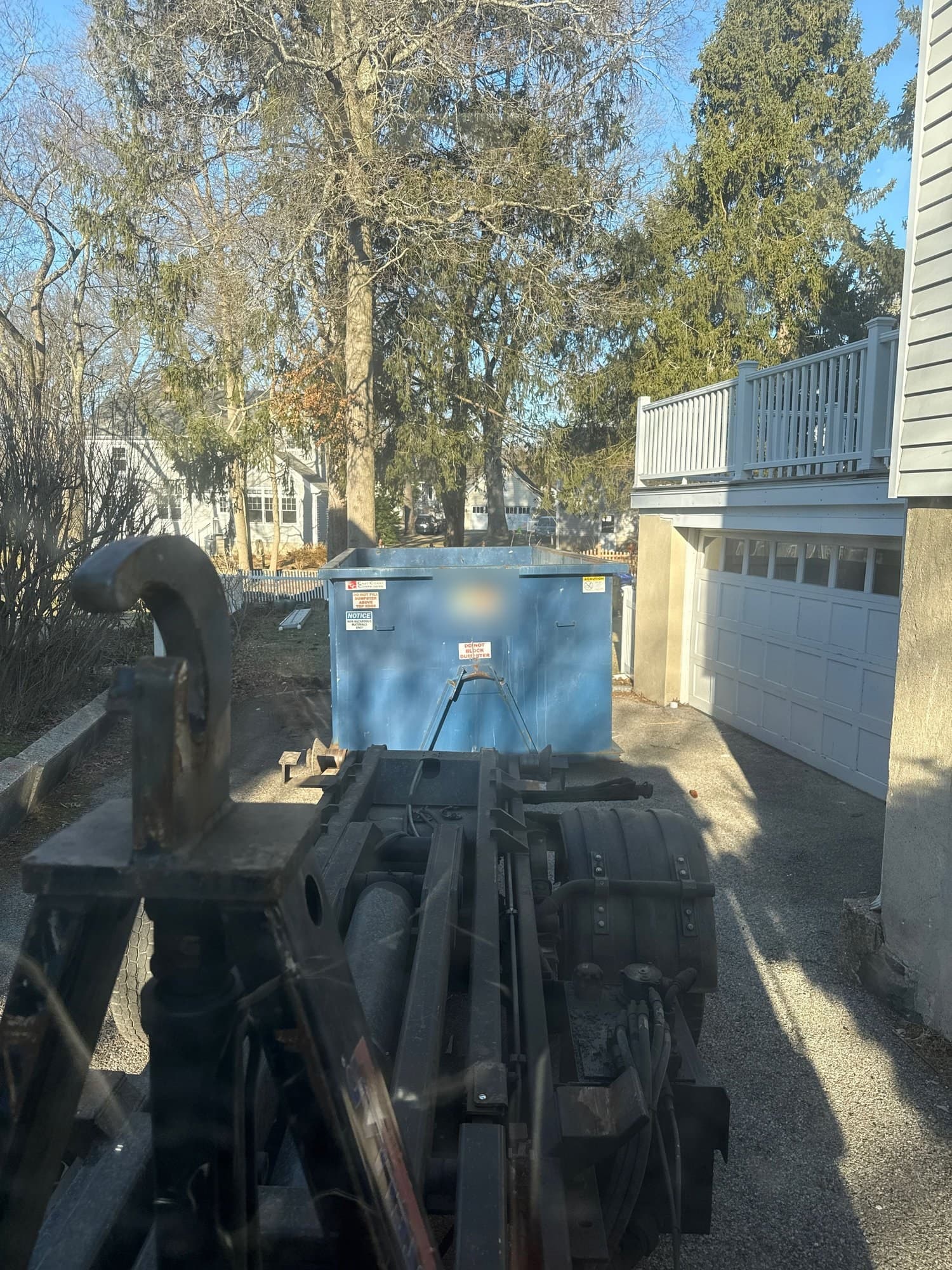
Wrong-size dumpster on a roof tear-off costs CT roofers real money. Either you under-sized and you're paying $0.10/lb in weight overage that wipes out your margin on the job, or you over-sized and you're paying for empty volume that didn't earn its keep. The math isn't complicated — but it requires knowing the difference between volume capacity and weight capacity, and how each tear-off type stresses the math differently.
The two numbers that matter: volume and weight
Every dumpster has both:
Volume capacity — how many cubic yards of material fit inside.
Weight capacity — how many pounds the truck can lift + the disposal facility can accept on a single load.
A 20-yard dumpster's volume is 20 cubic yards. Its included weight allowance is 4,000 lbs (2 tons). Overage beyond that runs at $0.10/lb — the transfer station's pass-through rate, not marked up by us. Roofing material specifically tends to hit the weight cap before the volume cap. That's the central planning insight.
| Dumpster | Volume | Weight Included | Overage Rate |
|---|---|---|---|
| 10-yard | 10 yd³ | 1,000 lbs (0.5 ton) | $0.10/lb |
| 15-yard | 15 yd³ | 2,000 lbs (1 ton) | $0.10/lb |
| 20-yard | 20 yd³ | 4,000 lbs (2 tons) | $0.10/lb |
| 30/40-yard tier | 2 × 20 yd³ (swappable) | 6,000 lbs (3 tons) across the tier | $0.10/lb |
Asphalt shingles — the most common roofing tear-off
Single-layer asphalt: ~240-280 lbs per square (one square = 100 sq ft of roof). Most common CT residential roof type.
Math for typical CT houses:
- 1,500 sq ft roof, single-layer: 15 squares × 260 lbs = 3,900 lbs. 20-yard at $647 fits comfortably within the 4,000-lb cap. Volume-wise: ~15-18 yd³ depending on packing density. Right size.
- 2,000 sq ft roof, single-layer: 20 squares × 260 lbs = 5,200 lbs. 20-yard's cap exceeded by 1,200 lbs → $120 overage. Still cheaper than 30/40-yard upgrade ($252 difference + capacity headroom you may not need). Honest call: 20-yard + planned overage.
- 2,500-3,000 sq ft roof, single-layer: 25-30 squares × 260 = 6,500-7,800 lbs. 30/40-yard tier at $899 (two 20-yard cans, swap-out flexibility). Weight cap is across the tier; volume gives you headroom for unexpected material.
- 3,000+ sq ft roof, single-layer: Multi-can rotation almost certainly. 30/40-yard tier + plan for at least one swap.
Double-layer tear-off: Same volume per square but ~2x the weight. Asphalt-over-asphalt tear-offs add weight without adding much volume.
- 1,500 sq ft double-layer: 15 squares × 520 lbs (double weight) = 7,800 lbs. 20-yard cap exceeded by 3,800 lbs → $380 overage on top of $647 base. Cheaper to start at 30/40-yard at $899 with proper weight allowance.
- 2,000+ sq ft double-layer: Always 30/40-yard tier. The math gets ugly fast.
Three-layer tear-off (rare but real): Old houses with 3 layers of asphalt shingles stacked over decades. Triple weight per square. Plan for swap dispatches with weight-conscious sequencing.
Slate roofs
Slate runs 700-1,000 lbs per square — about 3x asphalt's weight. Weight capacity becomes the only sizing variable that matters.
Math:
- A typical 2,000 sq ft slate roof: 20 squares × 850 lbs = 17,000 lbs total. Even the 30/40-yard tier's 6,000-lb allowance leaves $1,100 in overage.
- Better strategy: multiple 10-yard rotations. A 10-yard at $447 with 1,000-lb allowance + $0.10/lb overage. Three 10-yards swap-cycled (~$1,341 + overage) handles a 2,000 sq ft slate roof with better truck-fit logistics than one 30/40-yard fighting weight math.
Slate-specific reality: pieces are heavy, sharp, and you don't want them in a single huge load. Splitting across multiple swap cycles also matches a slate tear-off's natural rhythm — slate work moves slower than asphalt.
Cedar shake
Cedar shake runs 200-300 lbs per square — about 25% lighter than asphalt. Volume becomes the constraint.
Math:
- A typical 2,000 sq ft cedar roof: 20 squares × 260 lbs = 5,200 lbs (similar to asphalt single-layer weight). 20-yard's volume of 20 yd³ handles cedar shake comfortably; volume is the limiting factor before weight.
- For large cedar roofs (3,000+ sq ft): 30/40-yard tier for volume headroom, not weight. Cedar packs less tightly than asphalt, so plan for slightly less compaction.
Metal roofs
Metal panels and standing seam — variable based on gauge and material. Aluminum runs lighter (~50-100 lbs/square); galvanized steel heavier (~200-400 lbs/square).
Most CT metal roof tear-offs are smaller in volume than asphalt because the original panels are large flat sheets that bundle efficiently in the truck. A 10-yard or 15-yard often handles a residential metal tear-off. We size at the call based on roof size + metal type.
Same-day swap reality for active job sites
Roofing tear-offs run on tight schedules. A crew on day 2 of a 3-day tear-off doesn't want to wait 36 hours for a fresh dumpster when the current one fills up at noon. We swap same-day for in-area towns when you call before 11 AM and our morning route has capacity.
Same-day swap service area (high reliability):
- Fairfield County — 15-50 min from Stamford depot
- New Haven County — 10-30 min from West Haven yard
- Westchester County NY — Grizzly-coordinated, licensed local partners
- Southern Hartford, coastal Middlesex — 30-50 min
Next-day-default service area (same-day possible but not guaranteed):
- Hartford County mid-range
- Litchfield County closer-band
- East CT past Waterford
Tell us at the start of the project we may need swap dispatches and we'll keep capacity available. Most active roofing job sites in our same-day area run with the expectation of next-business-day-morning swap if you call after 11 AM.
Account setup for repeat work
CT roofing contractors with 10+ projects per year run more efficiently as commercial accounts. Account benefits:
- Single point of contact — me or Ashley on dispatch
- COI on file — annual update at renewal, named-additional-insured for GCs as needed
- Priority dispatch slotting when your projects stack up
- Net-30 terms — single monthly statement, all dispatches itemized
- Standing scope agreement — we know your typical project size + dumpster preference, quote consistently
- Weight-cap intelligence — we track your typical tear-off weight ranges and flag if a dispatch looks under-sized
Setup is a 15-minute phone call. See Commercial: Roofers for the workflow page.
Pre-job sizing checklist
Before booking, have these numbers ready:
- Square count (or roof sq ft / 100)
- Tear-off type (single layer? double? slate? cedar?)
- Approximate weight per square (use the numbers above)
- Total weight estimate (squares × weight/square)
- Volume estimate (squares × volume/square — for asphalt, ~0.5-0.7 yd³/square)
- Crew speed (how many squares per day) — drives whether you need single drop, swap cycle, or 30/40-yard tier
- Job site access (driveway approach, truck clearance, placement spot)
We can do this sizing on the phone in 3-4 minutes if you have rough numbers. For a 30-second project description we can get to a real recommendation: "1,800 sq ft single-layer asphalt tear-off, residential driveway, 3-day crew — 20-yard at $647 with planned $50-$100 overage budget." That's the math.
Where roofers + Grizzly intersect
Common project types we run with CT roofing contractors:
- Single tear-off + re-roof: one or two dumpster drops, often a 20-yard
- Multi-property roofing contractor weekend rotation: standing same-day swap on consecutive job sites
- Commercial re-roofs (small commercial, low-slope): 30/40-yard tier typical
- Storm-damage roofing surge: dispatch volume spikes after named storms; account roofers get priority placement
- Combined roofing + adjacent demo: sometimes the roofing job includes deck removal, chimney teardown, or other accessory-structure demo — we can scope both in one project
For broader contractor coverage, see construction debris removal in CT for contractors.
Booking
Phone first for roofing dispatches. (203) 219-8855, open 8 AM – 10 PM, 7 days (live team Mon–Fri 8 AM – 4 PM, AI phone assistant other times). We size the dumpster on the call, schedule the drop + any anticipated swaps, send the COI if it's a new account.
Dumpster instant quote form route works for single-drop standard jobs where you already know the size.
For commercial account setup conversations: Commercial: Roofers or call.
Sizing right protects margin. We've been sizing roof tear-offs for CT contractors since 2014 — the math is the math, and the right dumpster on day one beats the wrong one on day three.
Ready to talk through your project?
Call (203) 219-8855, 8 AM – 10 PM, 7 days; live team Mon–Fri 8 AM – 4 PM, AI phone assistant other times. Or use the instant-quote tools below.
Looking for service in your area?
We dispatch from two depots — Stamford and West Haven — across 5 CT counties, and Westchester County, NY is Grizzly-coordinated through licensed local partners. Each county page rolls up the towns we cover with dispatch and same-day-vs-next-day framing.
Related posts
- Industry Guides7 min read
Kitchen and Bath Gut Dumpster Sizing for Contractors
Kitchen debris is bulky and light; bath debris is small and dense. Sizing a gut job means planning for both — here's the working logic we use with CT contractors.
By Justin Hubbard - Industry Guides9 min read
Construction Debris Removal in CT
A working contractor's guide to CT debris hauling — sizing by material type, weight-cap math, same-day swaps for active job sites, and what commercial accounts actually unlock.
By Justin Hubbard - Industry Guides10 min read
Realtors: The Pre-Listing Cleanout Playbook
How CT realtors win pre-listing cleanouts in the first 48 hours — timeline, donation routing for seller tax basis, vacant home coordination, repeat-work account setup.
By Justin Hubbard
Answered 8 AM – 10 PM, 7 days; live team Mon–Fri 8 AM – 4 PM, AI phone assistant other times.