Do You Need a Permit for a Dumpster on the Street in CT?
The rule is simpler than the internet makes it: your driveway, no permit; the public street, permission first. What varies town to town is everything after that sentence.
20,000+
jobs completed
4.99 ★
463 reviews
Family-owned
since 2014 (12 years)
Licensed & insured
in Connecticut & New York
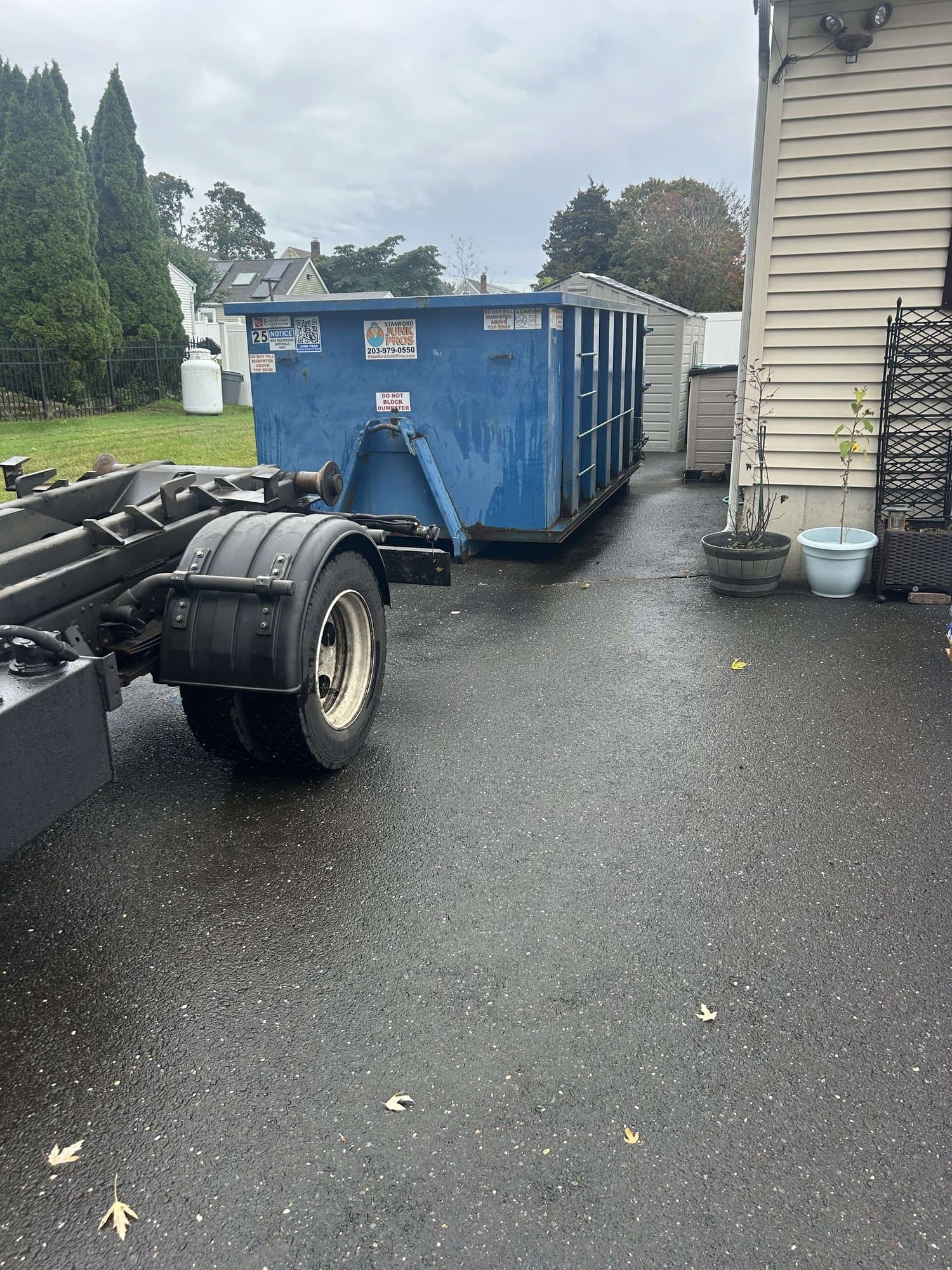
Permit questions are the most over-complicated topic in dumpster rental, so here's the entire legal architecture in two sentences. On your own private property — driveway, lawn, parking pad — a roll-off generally needs no permit in Connecticut towns. In a public street, on a sidewalk, or in the town right-of-way, you need the town's permission first — every time, everywhere.
Everything else you'll read on the subject is detail hanging off those two sentences. The details genuinely matter — fees, timelines, and which office answers the phone all vary town by town — but the decision tree starts and mostly ends with one question: whose ground is the can sitting on?
The private-property rule
Connecticut regulates dumpster placement at the municipal level, and towns regulate what happens in the public right-of-way — the street, the sidewalk, the strip the town owns. A container that sits entirely on private property is, as a general rule, not a permitted activity. That covers the overwhelming majority of residential rentals: every can we place on a driveway, and that's most of them, involves no paperwork at all.
Two honest caveats. First, "generally" is doing real work in that sentence — a town can have stricter local rules, historic-district overlays, or condo and homeowner associations with their own approval steps, and coastal association streets in our service area add private rules on top of public ones. Second, "private property" means your property: a shared driveway or a private road owned by an association is somebody's property, and that somebody may want a say. When any of this is in play, one call to your town's building or public works office settles it — before delivery day, not after.
The street rule
The moment any part of the can crosses into the public right-of-way, you're in permit territory — universally. Towns handle it under different names (street-obstruction permit, encroachment permit, right-of-way permit), with different fees, insurance requirements, and timelines, and that variety is why we won't publish a table pretending to cover them all. A stale permit table is worse than none.
What we can tell you from running cans across a hundred-plus towns:
- Dense downtowns are where this actually comes up. Blocks without private driveways — downtown Stamford, New Haven's multi-family streets, Hartford's triple-decker neighborhoods, West Haven's Center — are where street placement is sometimes the only option, and every one of those cities requires permission for it.
- Timelines range from same-day to about two weeks. Norwalk's encroachment permit, to name a documented example from our own service area, runs on roughly a two-week application timeline. Plan the permit before you book the can.
- The fee goes to the town, not to us. Whatever the town charges is between you and the town; our rate doesn't change based on where the can sits.
How to check your town in five minutes
- Search your town's own site for "dumpster permit," "street obstruction," or "encroachment permit." Town sites are the only source we trust for this — not aggregator blogs, including in some sense this one, which is why every specific claim here points you back to the town.
- No clear answer? Call public works (or the building department in smaller towns). Ask: "Does a roll-off dumpster on [street vs. driveway] need a permit, what does it cost, and how long does approval take?"
- Tell us what you learned when you book. We schedule delivery around the approval, and if the town wants placement specifics — cones, reflectors, distance from the corner — the driver handles the physical requirements.
Our town pages carry verified local permit notes for many of the towns we serve — each one sourced from that town's own site — and the delivery-prep guide covers the placement decision more broadly.
The operator's honest advice
Skip the street if you possibly can. A driveway placement needs no paperwork, no waiting, no cones, and no town involvement, and every can we run — any size — takes the same one-parking-spot footprint precisely so that driveways stay in play. The street is the right answer when it's the only answer; for everything else, the fastest permit is the one you never needed. And when the street is the only answer: check with your town first, every time. That sentence is the whole post.
Ready to talk through your project?
Call (203) 219-8855, 8 AM – 10 PM, 7 days; live team Mon–Fri 8 AM – 4 PM, AI phone assistant other times. Or use the instant-quote tools below.
Looking for service in your area?
We dispatch from two depots — Stamford and West Haven — across 5 CT counties + lower Westchester NY. Each county page rolls up the towns we cover with depot dispatch realities and same-day-vs-next-day framing.
Related posts
- Logistics5 min read
How Long Can I Keep a CT Dumpster?
Rental duration is the most-confusing aspect for first-time customers. Here's the real timeline — 7 days included, $15/day extensions, and when swap-out beats keeping.
By Justin Hubbard - Logistics6 min read
How to Prepare for a Dumpster Delivery
90% of failed deliveries are preventable. Here's the prep checklist — driveway clearance, overhead obstacles, surface protection, and where to put the bin for maximum usability.
By Justin Hubbard - Logistics7 min read
Same-Day vs. Next-Day Dumpster Rental
Most CT haulers advertise same-day delivery. Here's the honest version — when it actually works, what call timing does to your odds, and where next-day is the right answer.
By Justin Hubbard
Answered 8 AM – 10 PM, 7 days; live team Mon–Fri 8 AM – 4 PM, AI phone assistant other times.