Dumpster Size Guide: 10, 15, 20, 30/40-Yard
The most common sizing mistake we see is going one size up 'to be safe.' Here's what each of our four roll-off sizes actually fits — and when bigger isn't better.
20,000+
jobs completed
4.99 ★
463 reviews
Family-owned
since 2014 (12 years)
Licensed & insured
in Connecticut & New York
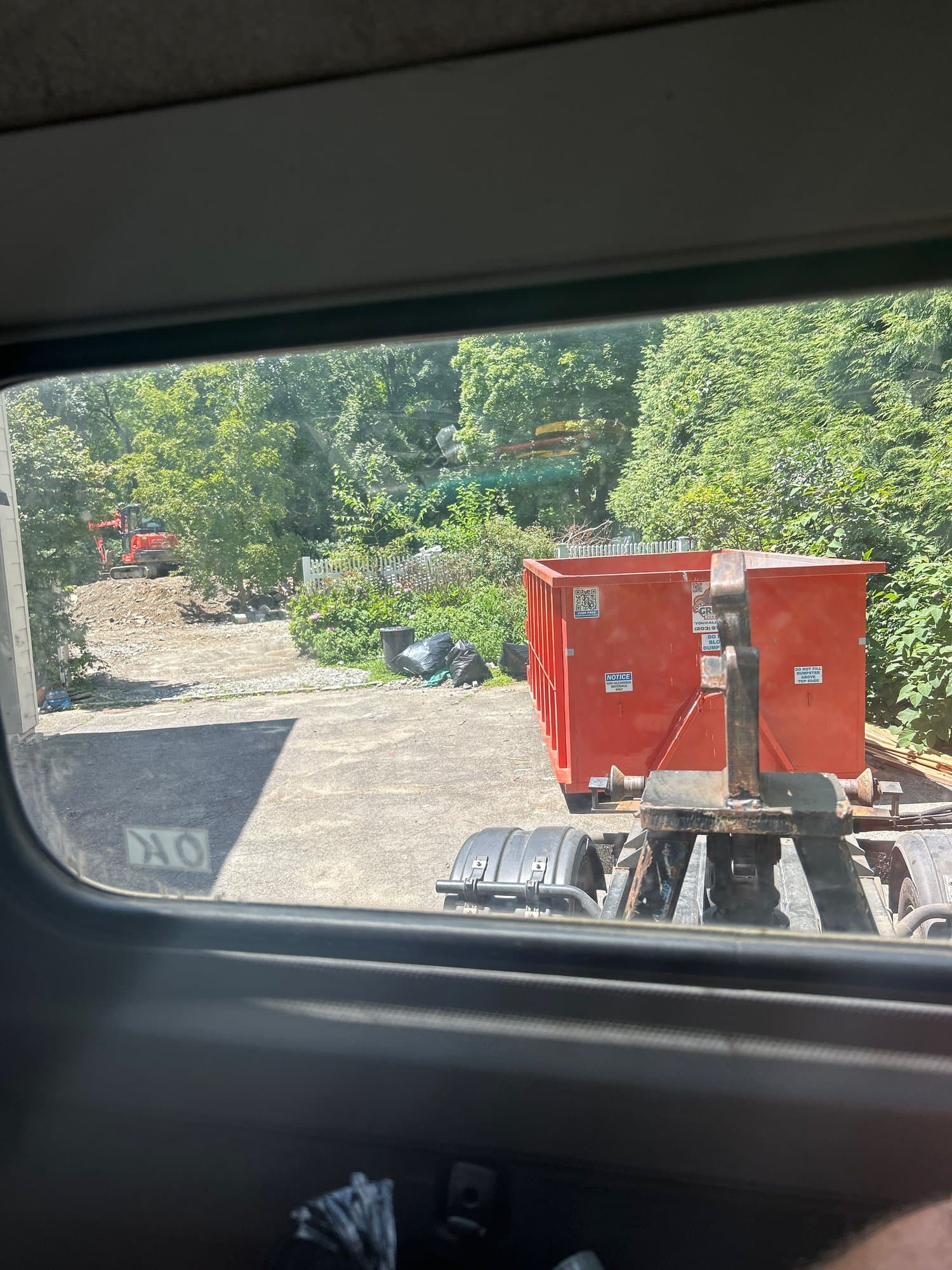
The most common sizing mistake we see — and we've done 20,000+ jobs since 2014 to know it — is people going one size up "to be safe." Bigger isn't safer. Bigger costs more, takes more driveway space, and creates a half-full bin you paid extra for. Right size beats safe size.
This post walks through what each of our four roll-off sizes actually fits, with real CT examples. If you're booking your first dumpster, this is the page to read before you call.
The four sizes — dimensions and weight
Every can in our fleet sits on the same footprint: 15 ft long × 8 ft wide — about the length of one parking spot. What changes with the size is the wall height (3 ft on the 10-yard, 4 ft on the 15, 5 ft on the 20) and the weight allowance included in the price — never the space it takes in your driveway.
| Size (package) | Price | What arrives | Weight Included |
|---|---|---|---|
| 10-yard | $447 | 15 ft × 8 ft footprint, 3-ft walls | 1,000 lbs |
| 15-yard | $547 | the same can | 2,000 lbs |
| 20-yard | $647 | the same can | 4,000 lbs |
| 30/40-yard | $899 | two of the same can — swap or split | 6,000 lbs |
Every size has a rear swing door with step-in access: you walk material in on a dolly or wheelbarrow instead of lifting it over the side.
All four prices include delivery, pickup, dumping, 7-day rental window, and the included weight allowance. No zone surcharges across our service area. Full pricing context lives on how pricing works.
One fleet, one can: every size we run arrives in the same full-size can, so what you're really choosing is the weight allowance, not the space in your driveway. Why we standardized the fleet that way — and what it means when the can looks half full — is on One Can. Every Job.
10-yard at $447 — the small, dense bin
The same full-size can as every other tier, with 1,000 lbs of weight included. The smallest package we run, and the most underused.
People skip the 10-yard because they assume it's "too small" — but for dense material (tile, plaster, asphalt shingles) it's often the right call. The 1,000-lb cap absorbs about 3 squares of shingles or a half-bath's worth of tile before $0.10/lb passthrough kicks in.
10-yard real-use examples:
- Single-bathroom gut remodel (tear out tub, tile, vanity, drywall)
- Small asphalt-shingle tear-off — about 3 squares within the 1,000-lb cap
- Small brush + branch landscape job — yard-waste volume light enough for the 10
- Single-room clear-out (one bedroom, a small office)
- Tight-driveway constraint where a 15 or 20 won't fit
When to skip it: anything over about 6 cubic yards of light material. Drywall, framing scrap, and household junk fill the volume fast — you'll run out of room before the weight cap matters.
15-yard at $547 — the most-overlooked sweet spot
The same full-size can, with 2,000 lbs included.
The 15-yard is what we recommend most often when customers describe a "kitchen reno" or "garage cleanout." It holds enough volume for the typical mid-size CT residential project, has enough weight headroom for mixed debris (drywall + cabinetry + flooring), and costs $100 less than the 20-yard.
15-yard real-use examples:
- Standard kitchen renovation (cabinets, countertops, appliances, flooring)
- Full garage cleanout — including the years-old paint cans you sorted out for hazardous waste day
- Single-room demolition — taking out a wall, redoing a den
- Mid-size landscape project — brush, branches, mulch. (Stumps and soil aren't accepted; refer to arborist + clean-fill hauler.)
- Bathroom + bedroom combo gut
When to skip it: if you're not sure between 15 and 10, you probably want the 15. If you're not sure between 15 and 20 — and the project is light material — go 15. If it's a contractor's whole-house gut or a roof tear-off, jump to 20.
20-yard at $647 — the most-popular size
The full can spec — 15 ft long × 8 ft wide with 5-foot walls, and a rear swing door for walk-in loading — and 4,000 lbs included.
The 20-yard is our most-booked size. It's what contractors call us for first, and it's right for any project that's bigger than "a room or two" but not yet "tear down the whole structure." Single-layer roof tear-offs fit about 13 squares within the 4,000-lb cap; past the cap is $0.10/lb passthrough.
20-yard real-use examples:
- Whole-house decluttering — estate cleanout, downsizing
- Single-layer roof tear-off, sub-2,500 sq ft, single asphalt layer
- Multi-room renovation — kitchen + bath, or two adjacent rooms
- Mid-size addition build-out (framing waste, drywall scrap)
- Contractor day-runs where you don't yet know the final volume
When to skip it: if you have heavy renovation debris (tile, plaster, asphalt shingles) — the weight ceiling will get you long before the volume does. Drop to a 10 or 15 and budget for weight overage. (Concrete and brick aren't accepted — different hauler.) If you have a two-story tear-off or a really big addition — jump to 30/40.
30/40-yard at $899 — two 20-yard bins, swap or split
This tier is delivered as two 20-yard bins rather than a single 30 or 40-yard. Same ~30-40 cubic yard total capacity, same 6,000-lb total weight allowance, but with three operational advantages:
- One can's space at a time — on the swap approach you only ever need room for one can in the driveway, never the whole tier at once.
- Split across two locations — multi-property estate cleanout? Both bins go to different addresses, same price.
- Swap-out flexibility — fill one, we swap it for a fresh empty mid-project. You don't have to pre-guess the final volume.
The 30/40 tier is what big residential demos, contractor jobs, and multi-day renovations look like.
30/40-yard real-use examples:
- Full additions or substantial renovation framing
- Two-layer roof tear-offs (the second layer doubles the weight math)
- Contractor jobs where you'll swap mid-project rather than pre-size
- Multi-property cleanouts — split the bins across two addresses
- Long landscape or excavation projects with mixed debris
When to skip it: anything that fits a 20-yard cleanly. The 30/40 is meaningful capacity — don't pay for it if you don't need it.
The "pick by job type" decision matrix
For the most-common CT projects we run:
| Project | Recommended Size | Why |
|---|---|---|
| Single-bath gut | 10-yard | Tight volume, mixed debris |
| Standard kitchen reno | 15-yard | Most-common kitchen call |
| Large custom kitchen | 20-yard | Cabinetry + flooring + drywall volume |
| Single-room demo | 15-yard | One-room scope, mixed debris |
| Whole-house gut | 20-yard | Volume-driven, sized for crew speed |
| Single-layer roof, under 2,500 sq ft | 20-yard | Weight-cap-aware |
| Two-layer roof, any size | 30/40-yard | Second layer doubles weight |
| Concrete driveway tear-up | Not accepted — different hauler | Clean-fill specialist |
| Tile and grout tear-out | 10-yard | Weight-constrained — dense reno debris |
| Garage cleanout | 15-yard | Years of accumulated mixed debris |
| Estate cleanout (full house) | 20-yard | Volume-driven; sometimes 30/40 |
| Small landscape (brush) | 10-yard | Light brush + branches fit volume |
| Mid-size landscape | 15-yard | Volume-driven |
| Full addition or major reno | 30/40-yard | Two-bin flexibility |
For projects that don't fit these patterns — call. (203) 219-8855, we answer 8 AM – 10 PM, 7 days (live team Mon–Fri 8 AM – 4 PM, AI phone assistant other times). Describing the project beats guessing the size.
Weight ceiling: the thing nobody mentions until it matters
Every dumpster has a weight ceiling tied to its size. Over the ceiling = $0.10/lb overage at the transfer station, passed through directly to your invoice (we don't mark it up).
Real weight math, for materials commonly hauled:
| Material | Approx weight/cubic yard | Accepted? |
|---|---|---|
| Concrete | 4,050 lbs | NO — different hauler |
| Dirt/soil | 2,200-2,700 lbs | NO — different hauler |
| Asphalt pavement / millings | 4,000 lbs | NO — different hauler |
| Asphalt shingles (per square = 100 sq ft) | ~300 lbs/square | YES |
| Mixed construction debris | 400-600 lbs | YES |
| Drywall | 500 lbs | YES |
| Wood/lumber | 200-300 lbs | YES |
| Household junk | 200-400 lbs | YES |
| Mattresses (each, count separately) | 50-100 lbs | YES ($50 each) |
Run the math. A 10-yard with 1,000 lbs included: about 4 cubic yards of mixed construction debris, OR ~3 squares of asphalt shingles. A 20-yard with 4,000 lbs included: about 8-10 cubic yards of mixed debris, OR ~13 squares of shingles. (Concrete and brick aren't accepted — different hauler.)
For roof tear-offs specifically — our roofer page has the per-square shingle weight math. Quick version: about 3 / 6 / 13 / 20 squares within each size's per-can cap (10 / 15 / 20 / 30-40-yard). Past the cap is $0.10/lb passthrough.
"I don't know what size — what do I do?"
Call. (203) 219-8855. The phone call works because we've done this 20,000 times — describing the project (size of space, type of debris, single vs. multi-session) gives us 90% of what we need to size you right.
If you'd rather not call, the instant dumpster quote tool walks through a few sizing questions and books the bin. The cutoff for same-day delivery is 11 AM.
For commercial / contractor work, the contractor page walks through sizing for active job sites with swap-out logic. For roofers specifically, the roofer page handles the squares-to-weight math. For demolition contractors, the demo-contractor page covers mixed-debris and heavy-load sizing.
The best dumpster is the right-sized one. Skip the "bigger to be safe" reflex — it costs you money and takes up driveway you'd rather have back.
Ready to talk through your project?
Call (203) 219-8855, 8 AM – 10 PM, 7 days; live team Mon–Fri 8 AM – 4 PM, AI phone assistant other times. Or use the instant-quote tools below.
Looking for service in your area?
We dispatch from two depots — Stamford and West Haven — across 5 CT counties + lower Westchester NY. Each county page rolls up the towns we cover with depot dispatch realities and same-day-vs-next-day framing.
Related posts
- Service Guides7 min read
Renting a Dumpster When You're Moving
Movers charge to ship everything you failed to throw away. A can in the driveway for packing week is the cheapest decision in the whole move — here's how to run it.
By Justin Hubbard - Service Guides8 min read
Junk Removal vs. Dumpster Rental
The most-asked CT customer question — when junk removal beats a dumpster, when a roll-off wins, and when a Grizzly Bag fills the gap between them.
By Justin Hubbard - Pricing11 min read
Dumpster Rental Cost in Connecticut
Real CT dumpster pricing from a Stamford-based hauler — four sizes from $447 to $899, what's included, what changes the price, and when junk removal beats a roll-off.
By Justin Hubbard
Answered 8 AM – 10 PM, 7 days; live team Mon–Fri 8 AM – 4 PM, AI phone assistant other times.